 Retro Replay Retro Gaming History, Reviews & Emulation
Retro Replay Review
Gameplay
LBX: Little Battlers eXperience makes the act of owning a tiny robot the point, rather than merely dressing up a conventional action RPG. Your LBX is a toy model powered by its own engine, and you can personalize both its appearance and its characteristics. That combination gives each battle a pleasing personal stake: you are not just selecting a character from a roster, but taking a machine you have shaped into the arena.
Combat happens in real time, which keeps the game moving faster than a menu-driven RPG. Battles take place in cardboard dioramas built as miniature versions of real locations, an appropriately playful stage for little combat robots. The behind-view action framing also keeps attention on your own LBX as the fighting gets underway, rather than turning each encounter into a distant tactical exercise.
The stylus matters a great deal here, and that is where your patience will be tested. If you enjoy the hands-on feel of 3DS touch controls, it helps LBX feel distinct from a standard button-led brawler. If you want immediate, conventional action inputs, the control dependence can be a barrier before the customization and combat rhythm start to click.
There is more reason to invest than solo fighting alone. You can trade robot cards and battle with two to six participants, including co-operative teams of two or three. That social angle suits the game’s collecting-and-customizing spirit well; comparing machines and taking a tailored LBX into a team fight is much more inviting than simply checking off another RPG encounter.
Graphics
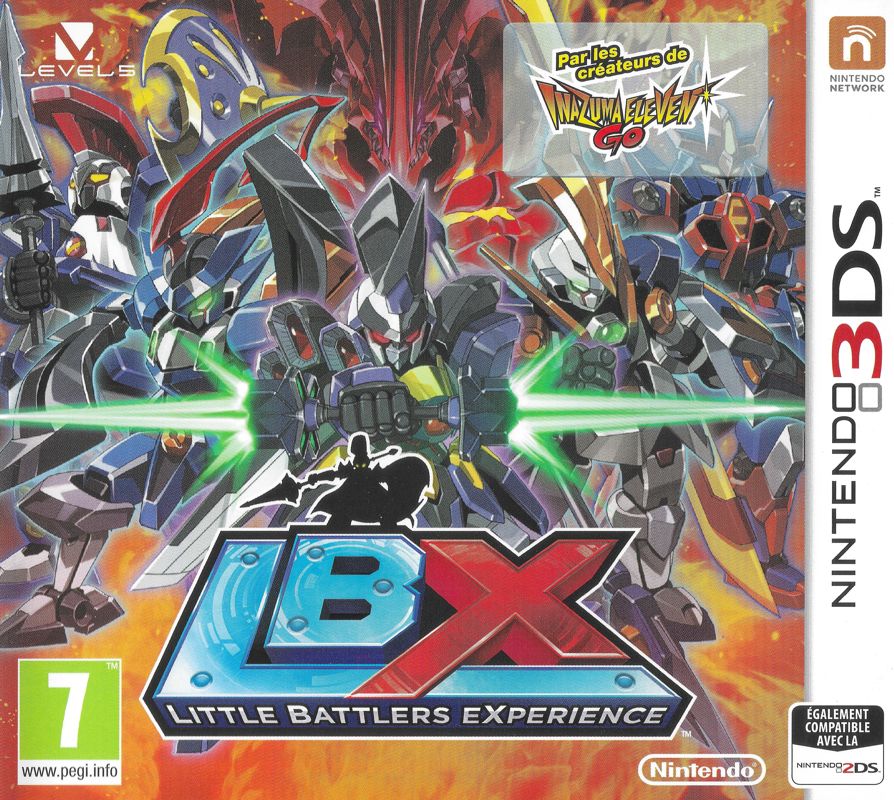
The look is straight anime-mecha: small robot models become animated combatants, and the cardboard dioramas give the arenas a deliberately miniature, toy-box flavor. Seeing a customized LBX move through these scaled-down locales is the game’s strongest visual image, and it fits the playful premise far better than a more realistic battlefield would.
Story
LBX’s storytelling hook is its world of customizable toy robots that come alive through small internal engines. It is a simple, accessible fantasy, but an effective one: the distance between collecting a model and piloting a battle-ready machine is intentionally very short.
The cardboard recreations of locales reinforce that childlike imagination. Fights are not framed as clashes between towering war machines; they are toy-sized showdowns played out across miniature spaces. That gives the game a lighter personality than many mecha RPGs, even when the action is active and direct.
If you want more background on the game and its release, the LBX: Little Battlers eXperience history is useful context. In the game itself, the strongest narrative pull comes from the basic desire to improve your own LBX and see how it performs once it is put into battle.
Overall Experience
This is an easy game to understand emotionally: make a robot yours, take it into an arena, and keep refining it. Level-5 and Climax Entertainment found a good match between action RPG progression and the model-kit fantasy. The concept carries the experience, especially when your customized machine starts to feel like a creation rather than a preset hero.
The trade-off is that LBX asks you to meet its stylus-centered control style on its own terms. That can create friction, particularly for anyone coming in hoping for a purely button-driven action game. Stick with it if the collectible-mecha angle has already caught your attention; that is where the game has the most to offer.
At 6.6, LBX is a likable, specialized recommendation rather than a universal 3DS essential. It is worth your time if anime robots, hands-on customization, and battling alongside friends sound like a better evening than a more solemn RPG quest. The payoff is the sense of ownership over your little fighter, not sheer spectacle.


Reviews
There are no reviews yet.