 Retro Replay Retro Replay gaming reviews, news, emulation, geek stuff and more!
Retro Replay Review
Gameplay
The first few minutes of Mahjong Cub3D feel reassuringly familiar: find two matching pieces, make sure they are free, remove them, and slowly dismantle the board. Then Cube Mode asks you to rotate the entire construction, and the puzzle becomes more interesting. Instead of merely scanning rows, you are checking faces and sides, looking for a cube whose notched edge is exposed. That small rule change gives the old Mahjong solitaire loop a convincing new dimension.
Cube Mode is the centerpiece, and it earns that status. Zooming out helps you understand the shape of the pile; zooming in lets you inspect the traditional symbols, dots, flowers, and characters on individual cubes. The satisfying part is not just spotting a pair, but recognizing that removing it will open another side and change the routes through the structure. You need a little patience while learning to read the notches, but it starts to click quickly.
Classic Mode is the dependable fallback. It uses the familiar flat stacks of Shanghai-style Mahjong, where a tile must have an open left or right side and no tile resting on it. There is no rotation to contend with, so it is the better choice when you want a quieter, more immediately legible puzzle. Clearing Cube and Classic boards unlocks more boards, giving the game a solid reason to come back beyond simply chasing a better time.
Optional hidden tiles and time limits let you tune the pressure, although time limits are only available once a puzzle has been completed. Limited hints are welcome when your eyes have gone stale, but they are not an endless escape hatch. The detailed completion, play-count, and time records give repeat runs a point without making the game feel like a scoreboard obsession.
Versus Mode is a clever change of pace for two people sharing the experience through one game card. Each person races to remove two gold tiles from their own Cube Mode puzzle, while special tiles can reveal good matches for you, blind your opponent’s tiles, or shake their board. Seeing the other puzzle update in the background makes the contest feel immediate. It is a nice competitive detour, even if the solo puzzles have more staying power.
Graphics
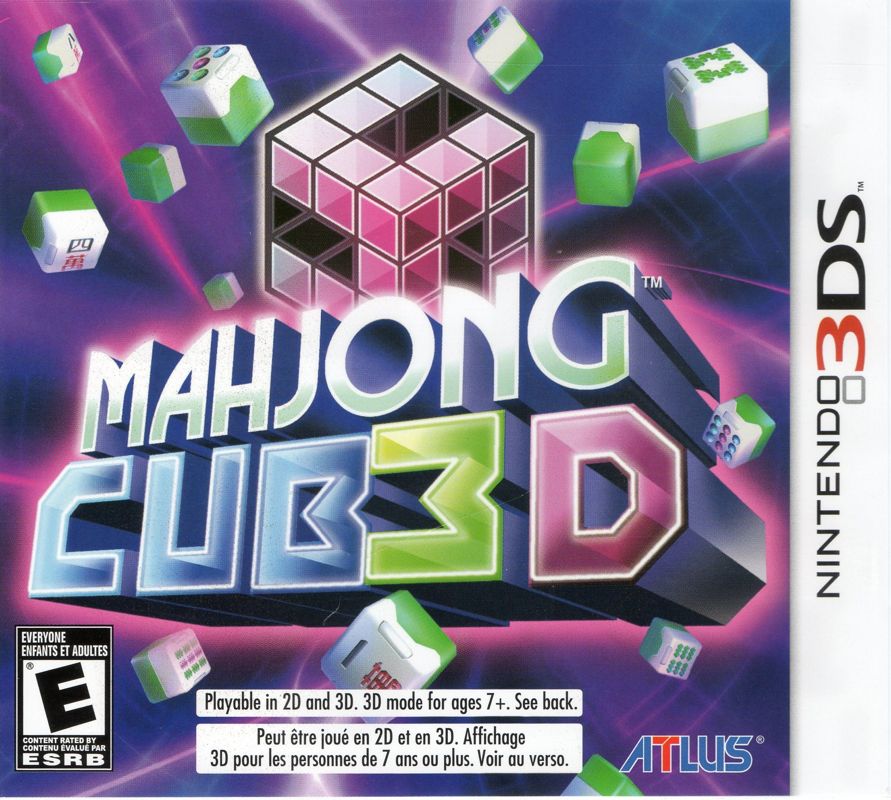
The cube boards are the visual hook. Traditional Mahjong markings sit on the faces of chunky blocks, while the notches on their sides show which cubes can be removed. Rotating the 3D structure and pulling the camera in or out makes it much easier to inspect a dense pile than a static screenshot would suggest.
Classic Mode looks appropriately plain beside it: stacked tiles on a 2D plane, built for quick scanning rather than flair. That simplicity suits the mode, while Cube Mode supplies the more distinctive image.
Story
There is no narrative to carry Mahjong Cub3D, and it does not need one. This is a puzzle game built around the rhythm of observation, selection, and gradually opening a blocked board.
Its sense of progression comes from the boards themselves. You begin with three Cube courses of 20 puzzles, unlock more Cube courses by completing puzzles, and also have 20 Classic maps to work through. That is a straightforward structure, but it fits a game where the real drama is whether you have preserved enough open pairs to finish.
If you want context around the game’s release and history, this Mahjong Cub3D overview is useful. In the game itself, though, the only story is the one you make from a stubborn layout finally collapsing into its last matching pair.
Overall Experience
Mahjong Cub3D is a modest but worthwhile spin on a durable puzzle format. Its best idea is also its simplest: turning tiles into cubes makes you reconsider the familiar rules rather than replace them. When you are in the mood for a thoughtful ten-minute clear, the rotation and exposed-side rule give your brain one more useful thing to chew on.
Frustration can arrive when a crowded cube pile hides the match you need, particularly with hidden tiles enabled, and limited hints mean you cannot casually brute-force every dead end. Still, that friction is part of the point. The game rewards slowing down, changing the angle, and planning removals instead of chasing the first visible pair.
The 6.6 score feels fair: this is not an essential reinvention, but it is more inventive than another plain Mahjong solitaire collection. Give it a chance if you already enjoy Shanghai-style clearing puzzles and want a portable version that makes spatial reasoning central. If you only want the traditional flat-board routine, Classic Mode is here, but Cube Mode is where Mahjong Cub3D justifies itself.



Reviews
There are no reviews yet.