 Retro Replay Retro Gaming History, Reviews & Emulation


Retro Replay Review
Gameplay
The first few matches make Swords & Soldiers feel wonderfully direct: train a unit, watch it join the march toward the enemy camp, then decide whether this next clash needs reinforcements, a better counter, or a spell. By putting the battlefield on a single side-scrolling lane, the game strips away the fiddly camera work and sprawling base layouts that can bog down traditional RTS games. You are still harvesting gold, building toward stronger options, and fighting for map control, but every decision arrives quickly and has an obvious consequence.
That simplicity does not mean the game plays itself. Since units keep walking toward the enemy after you create them, a careless production queue can feed troops into a matchup they cannot win. The real work is reading what is coming, maintaining gold income, researching at the right time, and using magic to bend a crowded melee in your favor. There is a satisfying rhythm to it once it clicks: income funds the army, the army creates space, and that space gives you the breathing room to reach more dangerous units and spells.
The three factions give that loop welcome variety. Vikings lean into durability, healing, fast mana recovery, and long-range catapult pressure. Aztecs trade sturdiness and mana recovery for nastier tricks, including poison, imprisonment, domination, and unit sacrifice to regain mana. The Chinese bring explosive power to ranged forces, while their monkey can leap past opposing units to threaten the rear. These are not minor stat changes; they ask you to value different resources, timings, and answers.
The campaign wisely unlocks a faction’s tools over time, so you are not asked to absorb every possibility at once. Skirmish mode opens the full roster, though you still need to research your way through its compact tech tree during a match. Challenges and multiplayer add useful reasons to keep experimenting after the scenarios. Frustration tends to set in when a bad counter choice or neglected economy snowballs, but that is also why victories feel earned rather than automatic.

Graphics
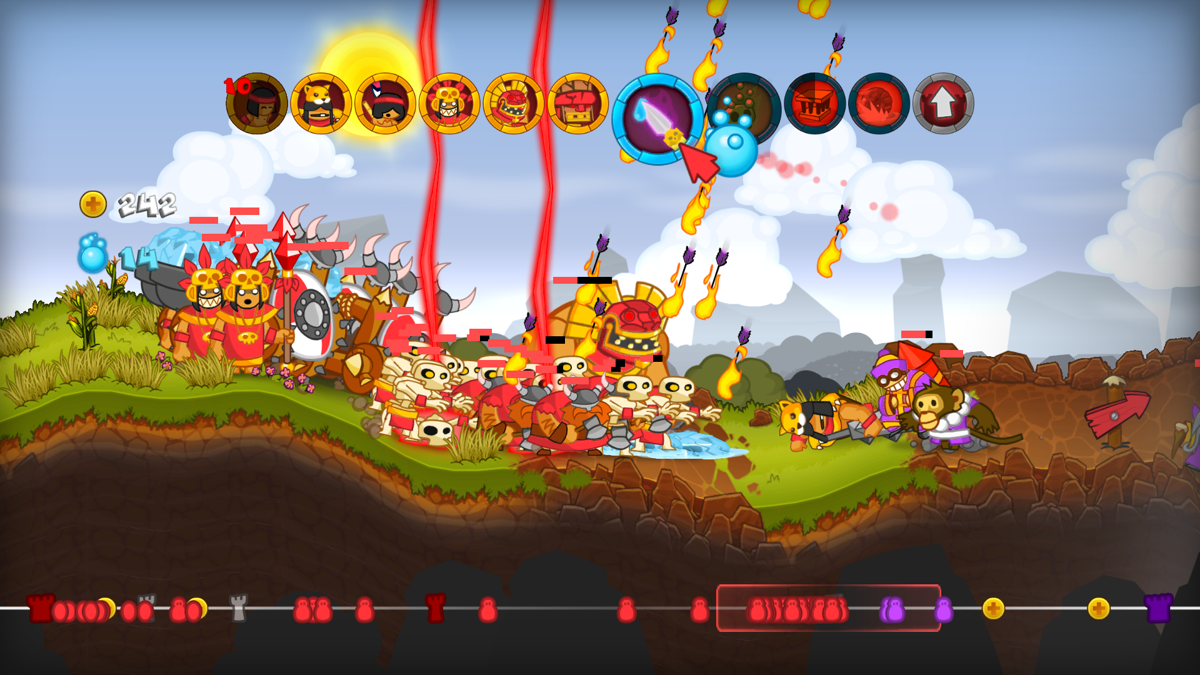
The side-view battlefield keeps both armies, their clashes, and the route to each camp in clear view. It is a sensible fit for a strategy game built around streams of units meeting in the middle: you can follow the push and immediately see when enemies are closing in on a vulnerable back line.
Story
The campaign is divided among Viking, Aztec, and Chinese scenarios, with each group carrying a distinct difficulty level and set of tools. More importantly, the campaign structure works as a tutorial without feeling like a separate training mode, because new units, buildings, and spells arrive as part of your progress.
Do not come expecting the story to be the main reason to play. Its practical value is in moving you through three contrasting strategic styles and steadily expanding what you can do. That approach makes the early hours inviting, particularly if conventional RTS games often lose you under a mountain of options.
The faction progression also gives the campaign a stronger sense of momentum than a string of disconnected battles would. Learning to heal and regenerate mana as the Vikings feels different from leaning on Aztec sacrifices and disruption or using Chinese explosives and rear-guard pressure. Each scenario has a reason to exist because it teaches a new way to think about the same battlefield.
Overall Experience
Swords & Soldiers is a smart answer to anyone who likes the strategic pressure of real-time strategy but not the usual burden of managing a huge map and an overstuffed base. Its side-scrolling format narrows your focus without removing the important choices. You still need to scout the flow of battle, protect your economy, counter the enemy, and time your spells; you simply spend less time wrestling the interface around those decisions.
The payoff is strongest when you begin to recognize that a battle is lost before the lines even meet—or that one well-timed spell, research choice, or specialist unit can reverse it. The faction differences keep that lesson from becoming routine, and skirmishes let you test the full toolset once the campaign has introduced it.
If you want a deep simulation of every RTS system, the streamlined battlefield may feel too narrow. But if you want an accessible, lively strategy game where the action is always visible and your decisions matter immediately, this is an easy recommendation. It makes a complicated genre feel inviting without making it toothless.

Reviews
There are no reviews yet.