 Retro Replay Retro Gaming History, Reviews & Emulation

Retro Replay Review
Gameplay
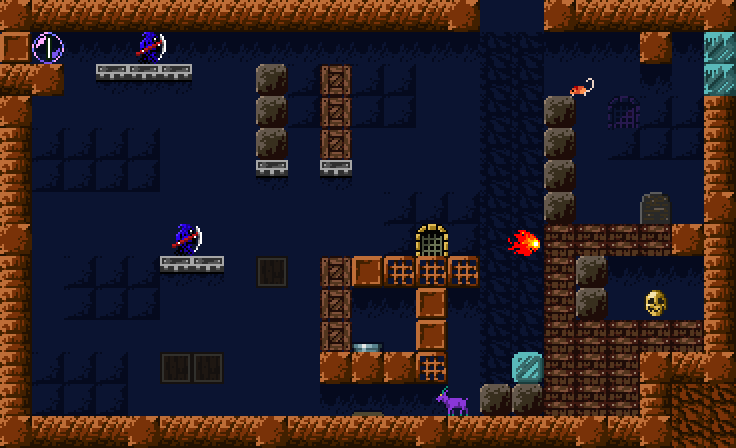
Escape Goat starts with the satisfying snap of a good one-screen platform puzzle: you can see the exit, you can see the immediate obstruction, and you know there must be a route through. The goat runs, jumps, double jumps, and dashes in midair, so simply moving around feels much more agile than its compact rooms initially suggest. That mobility is important because these are not slow, grid-bound logic puzzles. You are often trying to understand a room while also executing a jump cleanly.
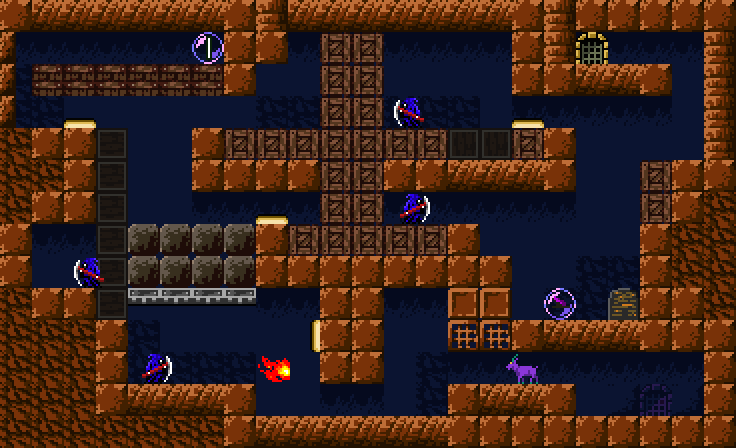
What makes the game stick is how quickly its rooms turn familiar platforming furniture into puzzle pieces. Keys open doors, triggers and skeleton heads shift blocks, some blocks crumble, and others can be pushed into position. Enemies are not merely obstacles: getting into their line of sight can make their projectiles break down or melt blocks for you. When that clicks, the rooms stop feeling like a set of traps and start feeling like small chain reactions waiting to be arranged.
The mouse is the standout wrinkle. You can send it through narrow passages the goat cannot enter, then activate the magical hat to teleport to its location. That is a simple idea with a lot of leverage, and it gives later solutions a pleasing “wait, I can be over there” moment. It also means the game asks you to think about two bodies and two routes without burying that thought under a large map.
Frustration is part of the package. A room can leave you staring at a door or block arrangement until you recognize the intended interaction, and precise movement still matters after you have solved the idea. Fortunately, the fixed-screen structure keeps the pain contained: you are never trudging back across a huge level just to test a theory. On Windows, the expanded set reaches 100 levels, and completion unlocks replay access across them for anyone who wants to revisit solutions quickly or chase faster runs.

Graphics
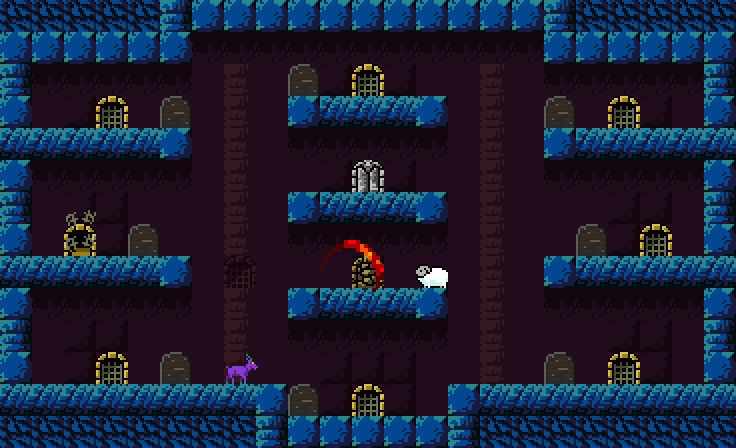
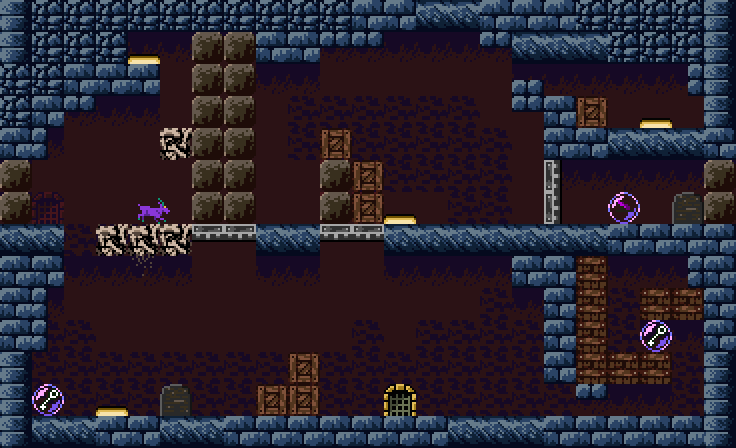
The side-view, single-screen rooms keep every important piece in view: the goat, keys, doors, movable blocks, enemies, and exit all share the same compact playfield. That framing is especially helpful once a puzzle involves luring enemy projectiles or moving the mouse through a tight passage, because you can read the whole problem at a glance.
Story
Escape Goat keeps its premise wonderfully spare: a goat is trying to reach the exit. There is no need for a grand detour when each room already supplies its own tiny drama—one blocked door, one tempting key, one suspicious trigger, and a route that only becomes obvious after you rethink the space.
That minimal setup suits the game’s rhythm. You are not being pulled forward by plot turns; you are pulled forward by the need to see what the next room will do with the tools you have learned. The magical hat and mouse add just enough oddball character to make the repeated escape goal feel playful rather than sterile.
If you need a platformer to build toward a larger narrative payoff, this will feel lean. If you like games that let the puzzle itself provide the momentum, its lack of narrative clutter is a strength. For game-specific release history, see the Escape Goat overview.
Overall Experience
Escape Goat is easy to recommend to anyone who likes platformers that expect you to pause, inspect, and experiment. Its best moments come from realizing an enemy is a tool, spotting a mouse-sized route, or turning a seemingly useless block into the last step of an escape. The controls give the goat enough athleticism that the solving never becomes purely abstract.
The trade-off is that the game can be stubborn. You will occasionally know every object in a room and still not see the sequence that joins them. Yet the one-screen format is a smart antidote to that irritation: the problem is always right there, small enough to pick apart and retry. Persistence tends to feel rewarded rather than exploited.
The larger Windows edition’s 100 rooms offer plenty to chew through, while its level editor and sharing tools give dedicated puzzle makers another reason to linger. Even without making your own rooms or speedrunning completed ones, the core campaign has a clean, focused arc of escalating spatial tricks. It is a compact puzzle platformer with sharp ideas and the confidence to let you discover them yourself.
Give it a chance if you enjoy the overlap between dexterous platforming and deliberate room-solving. Skip it only if repeated trial, small-scale precision, and occasional head-scratching are deal-breakers. For everyone else, Escape Goat turns a simple run to the exit into an impressively dense series of little victories.


Reviews
There are no reviews yet.