 Retro Replay Retro Gaming History, Reviews & Emulation



Retro Replay Review
Gameplay
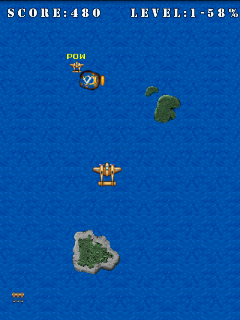
Pacific Wings is immediately familiar in the best and most limiting sense. You steer a plane up a vertically scrolling battlefield, enemy aircraft arrive, and your guns fire automatically. That leaves your full attention on positioning: slipping around hostile fire, lining up targets, and resisting the urge to fly into danger simply because a cluster of planes looks too satisfying to leave alone.
The opening minutes have a pleasant arcade snap. Each kill adds between 10 and 500 points, and the 5,000-point extra life target gives a shaky run a useful lifeline. Power-ups dropped by certain enemies increase your firepower, creating the simple but reliable shooter pleasure of turning a fragile starting craft into something much more capable.
Automatic firing makes the game accessible, but it also narrows what you do from moment to moment. This is about dodging and route choice rather than managing separate weapons or mastering a complex attack system. When the action becomes crowded, that clean focus can be tense; when you want more layers than score, lives, and stronger shots, it can start to feel slight.
Control options matter here. You can drag the plane on the touch screen, or use an on-screen d-pad, trackpad, or tilt control. Try more than one rather than forcing yourself to adapt to the first choice: in a shooter where survival depends on small movements, the control method that feels natural will do more for your enjoyment than any power-up.

Graphics
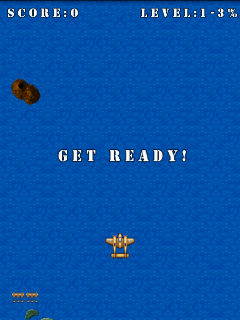
The game uses a 2D, top-down view with the battlefield scrolling vertically beneath your plane. Aircraft and their shots are the focus, in a deliberately old-school style close to the World War II arcade shooters that inspired it. The view keeps the important information where you need it: your craft, incoming enemy planes, and the space available to dodge.
Story
Pacific Wings uses its World War II setting as a direct arcade setup: you are in a fighter plane, enemy aircraft fill the route ahead, and the immediate job is to shoot them down without being shot down yourself.
That bare-bones framing fits the game’s brisk pace. There is no need to pause and interpret a complicated objective when bullets are already coming toward you; the war theme gives the planes and combat a recognizable context and then lets the score chase take over.
Come for the airborne action, not a dramatic wartime tale. The strongest sense of progress comes from lasting longer, gaining firepower, and pushing toward the next extra life rather than from narrative momentum.
Overall Experience
Pacific Wings is a compact, straightforward vertical shooter with a solid understanding of why this format endures. The first hour can disappear in repeated attempts to improve a run: one more life, one more power-up, one less careless collision. It does not bury that loop under unnecessary complications.
Its main weakness is also its point of view. The same simplicity that makes it welcoming can leave experienced shooter fans wanting a more demanding set of systems to learn. If you need every run to unfold differently through elaborate weapons or objectives, the automatic shooting and narrow focus may wear thin.
Still, there is value in a game that knows exactly how much it wants from you. Pacific Wings is worth a look if you want a clean, portable-feeling arcade challenge built around weaving through enemy formations and chasing a higher score. Give it a chance with the control scheme that clicks, and its uncomplicated rhythm is easy to appreciate.


Reviews
There are no reviews yet.