 Retro Replay Retro Gaming History, Reviews & Emulation
Retro Replay Review
Gameplay
Your first few matches get their energy from the roster more than from any grand competitive ambition. Putting Edward and Alphonse on one team feels right, but Dream Carnival is happiest when it lets you break the usual lines: Roy can stand beside Scar, or other normally opposed characters can be paired for the sake of a tournament joke. That fan-service freedom is the point, and it gives the game a nice, playful reason to exist beside the more serious Fullmetal Alchemist stories.
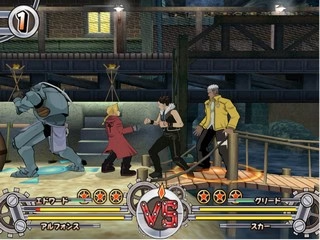
The fighting is built around running, jumping, character-specific normal attacks, and special attacks, so each match has a direct, accessible rhythm. You move in, look for an opening, and lean on the personality of whoever you chose rather than navigating an intimidating pile of systems. The cast does a lot of the work. Edward, Alphonse, Winry, Lust, Gluttony, Scar, Roy, Riza, Armstrong, and Hughes give you a lineup with enough familiar favorites to make team selection part of the fun.
Four fighters sharing the same side-view space is also the game’s clearest limitation. It can be hard to give a confrontation much individual weight when allies and opponents crowd the screen at once. The format favors messy group encounters over the clean tension of a one-on-one duel, and that will frustrate you if you came hoping for a tightly focused fighter.
That does not make the two-on-two setup a mistake. It gives Dream Carnival its own loose, social flavor, especially when you are more interested in seeing which characters can coexist than in preserving the series’ usual alliances. Go in wanting a spirited franchise crossover within its own cast, not a deep replacement for more dedicated fighting games.
Graphics
The active battles use chunky cel-shaded 3D characters with strong black outlines and flat color blocks. On the industrial dock stage, Alphonse’s bulky gray armor and Edward’s red coat stand out especially well against green water, metal railings, warehouse walls, and green steel beams. Scar’s yellow coat also cuts through the muted gray-green and brown background.
The camera’s side view keeps all four fighters in sight, though the small character figures and busy dock scenery can make crowded exchanges look cluttered. Lit windows and lamps add some warmth to the dark industrial setting, while the bold outlines help the cast stay distinguishable when the screen gets hectic.
Story
Dream Carnival does not try to retell the tragic sweep of Fullmetal Alchemist. Its martial arts festival setup is a comic excuse to assemble the cast, bend the usual rivalries, and get everyone into fights. That lighter framing is a sensible match for a two-on-two brawler, even if it lowers the stakes considerably.
If you are attached to the anime and manga’s emotional weight, this is best treated as a detour rather than a major dramatic chapter. The reward is the novelty of combinations that the core story would not naturally permit. The tradeoff is that the tournament premise cannot carry the same urgency as an adventure centered on the Elric brothers’ larger journey.
That distinction matters when choosing between the PS2 adaptations. Fullmetal Alchemist and the Broken Angel is the separate PS2 action RPG to consider if you want a more adventure-oriented take on the property. Dream Carnival is for the lighter, match-by-match version of the cast.
Overall Experience
Dream Carnival is a modest but likable licensed fighter that understands one important thing: a Fullmetal Alchemist game can be enjoyable simply because it lets you put these characters in an absurd tournament together. Its best moments come from choosing a team, recognizing the personalities involved, and accepting the cheerful nonsense of pairings that would be impossible or hostile elsewhere.
The crowded four-character battles and limited narrative weight keep it from reaching beyond that premise. You are unlikely to come away with the sense of a major Fullmetal Alchemist adventure, and the action can lose clarity when everyone converges. But the simple structure makes it easy to pick up for a few matches, particularly if the roster is the main reason you are here.
Give it a chance if you want an offbeat 2003-anime-era curiosity with a recognizable cast and a playful tournament tone. Its August 26, 2004 PS2 release sits among the franchise’s early adaptations in the official Fullmetal Alchemist chronology, and it remains a notably different proposition from the series’ more story-driven games.


Reviews
There are no reviews yet.