 Retro Replay Retro Replay gaming reviews, news, emulation, geek stuff and more!



Retro Replay Review
Gameplay
The first hour asks you to slow down and actually look at the apartment building. An animal acting nervous, an object that seems out of place, or a human reacting oddly can be the clue that an invisible alien is close. That is a far more engaging hook than simply being told where to go: you start scanning each room like a detective, testing your suspicions with the Cosmic device and lining up a photograph before the moment slips away.
The ten-photo limit per visit gives every shot some weight. You cannot just fill a roll with hopeful guesses and expect progress, especially because you must return to Mother for the negatives to be eaten, developed, and judged. A failed picture can feel deflating after careful setup, but it also makes a successful rescue genuinely satisfying. The game is at its best when you notice a tiny behavioral clue, realize what it means, and commit to the shot.
Time is the other major puzzle piece. Different rooms and different times of day matter because the building’s inhabitants follow schedules, so a clue that goes nowhere in one visit may make sense later. New successful photographs unlock further areas and times, giving the investigation a steady sense of expansion. If you enjoy adventure games that reward attention and experimentation more than speed, this structure has real pull.
Frustration will set in if you need constant explicit direction. The game deliberately makes you infer the rules of a situation from what you observe, and the photo limit means mistakes have consequences. Still, the restrictions serve the premise well: capturing invisible aliens ought to feel a little uncertain. Patience is not optional here, but the payoff is a puzzle game where observation feels like a skill rather than busywork.

Graphics
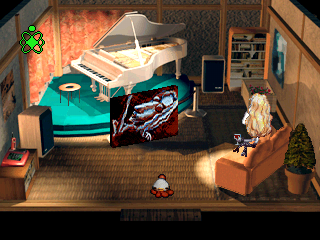
The view keeps the apartment building and its rooms in a top-down perspective, which suits a game built around noticing small changes in familiar spaces. Love-de-Lic’s eccentric character designs help the ordinary setting feel pleasantly odd, and the alien hero looks at home amid humans and animals who may be reacting to something you cannot see.
The gibberish dialogue, paired with subtitles, adds to the game’s playful, slightly alien tone. It is a charming fit for a story about a tiny extraterrestrial carrying out a bizarre rescue operation in the most everyday of places.

Story
The setup is simple and immediately funny: after a UFO crash, more than fifty aliens are stranded in an Earth apartment building, and Mother sends one small alien to retrieve them. The complication is that the missing aliens are invisible, while Mother judges your evidence by eating the negatives and producing the photos herself. It is strange in a very deliberate, memorable way.
Rather than leaning on a sprawling sci-fi plot, the story gives purpose to each investigation. Every acceptable photograph is not just a solved puzzle; it is proof that another lost alien can be found and brought home. That direct link between the premise and your actions keeps the game focused.
The apartment building is a smart choice of setting because it turns daily life into evidence. People and animals are not merely background dressing when their behavior can point to an alien nearby. The day-and-night schedule gives the setting a lived-in rhythm, and the odd dialogue keeps the tone from becoming too dry or procedural.
Overall Experience
UFO: A Day in the Life is a distinctive puzzle-adventure because it trusts you to notice things. Its best moments come from turning an ordinary clue into an answer: a room feels slightly wrong, someone reacts in a suspicious way, and you finally understand where to point the camera. Few games make careful observation feel so central to the act of play.
The price of that originality is occasional friction. Limited photographs and time pressure mean you will not always make progress cleanly, and the game can be demanding when its clues do not click. But that same resistance keeps the rescue work from feeling automatic. You are piecing together behavior, place, and timing, not just executing a checklist.
Give it a chance if you like eccentric adventure games and puzzles that ask you to read a space rather than merely search it. It will not suit anyone looking for brisk action or constant guidance, yet its weird humor, invisible-alien premise, and satisfying detective logic make it well worth the patience for the right gamer.


Reviews
There are no reviews yet.