 Retro Replay Retro Gaming History, Reviews & Emulation
Retro Replay Review
Gameplay
The hook here is not simply that you travel through time. You go to the past because the people you need cannot come forward with you, then learn their trades and techniques so the present-day party can face the coming Teras Pharma threat. That makes character growth feel tied to the adventure instead of pasted on top of it. If you enjoy RPG systems that turn story logic into a reason to experiment with your team, Tsumugareshi Hyakunen no Toki has a genuinely smart foundation.
Combat keeps the familiar Suikoden scale: six combatants, arranged across front, middle, and back rows, in turn-based fights. Enemies appear on the field rather than arriving through random encounters, so you usually have a choice about whether to engage. That alone makes exploration less abrasive than an old-fashioned random-battle grind, while the large party encourages you to think about placement and roles instead of relying on one all-purpose lineup.
Professions give that lineup-building more texture. Characters can pass learned techniques to allies in the same profession, and repeated meals with companions can open an additional profession for a character. The result is a system that asks you to invest in relationships and then rewards you with more options at the weapon-selecting stage. It is a more deliberate form of customization than simply handing out interchangeable spells, and it fits the game’s emphasis on knowledge handed down across generations.
There is one important caveat for longtime Suikoden devotees. Recruiting 108 people does not mean 108 potential battle regulars. Only a smaller core joins the main combat roster, while other recruits work at headquarters or teach skills. That can still make recruitment meaningful, but it changes the fantasy from assembling an enormous army of playable oddballs to building a supported team around a defined group.
Graphics
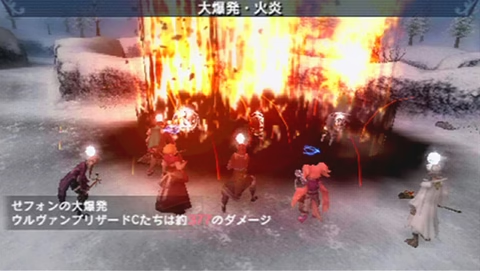
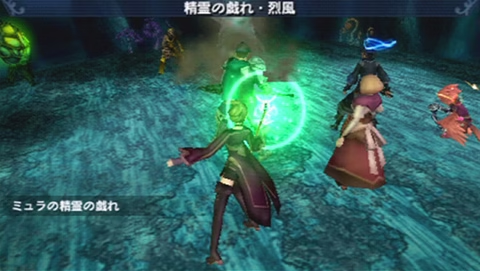
Battle scenes use small 3D anime-styled fighters on muted terrain, including snowy gray woods and teal stone floors framed by dark columns. Distinct costume colors help separate the party at a glance: burgundy cloaks, dark tunics, bright reds, and a white coat stand out against those restrained backdrops. The character models and floor textures look coarse at PSP resolution, but the battlefield layouts remain easy to parse.
Magic brings the screen to life. A bright green swirling circle, a colorful winged enemy, and heavy orange-yellow fire effects give battles a welcome burst of color. The largest fire attacks can cover nearby figures, though, so the flashiest moments are not always the clearest ones.
Story
A mother’s tale about ancestors who fought the Teras Pharma nearly a century earlier shapes the hero into a swordsman determined to meet their return. That is a classic RPG call to adventure, but the game quickly gives it more weight by putting the hero alongside Myrna and Zeno, confronting them with hostile creatures, and sending them toward a stranger named Xephon and a strange route into the past.
The time-travel premise has more purpose than a simple tour of historical scenery. The ancestors want to help defend the future, yet cannot cross into it themselves. Asking them to train their descendant is a clean, emotionally sensible solution, and it lets the story treat inherited skills as something personal rather than merely convenient RPG progression.
Political trouble between the Ionian Empire and the Vermilion Axe runs alongside the monster crisis. That gives the world a second source of tension and keeps the looming Teras Pharma from being the only concern on the table. As an alternate-world Suikoden, it has room to tell its own conflict without requiring you to treat it as a direct lead-in to the main series.
Overall Experience
Tsumugareshi Hyakunen no Toki is most compelling when its systems and premise meet in the middle. Learning from past masters, passing techniques among compatible allies, and assembling a six-person party all make the generational theme feel active. It does not just tell you that history matters. It asks you to build around that idea.
The tradeoff is that its version of Suikoden is more contained than the recruitment number initially suggests. Menu-based towns remove some of the pleasure of physically wandering through settlements, and the limited playable roster may sting if your favorite part of the series is trying every newly recruited character in battle. Go in wanting a curated party-development RPG, not an endlessly expandable army simulator.
For broader context, Suikoden II shows the earlier main-series tradition of recruiting allies and fielding six-person groups that this spin-off draws from, though this story stands apart from it. The game’s original launch framing also makes its time-travel focus clear in Konami’s PSP launch announcement. If the thought of shaping modern heroes through the expertise of their ancestors sounds more exciting than wandering fully explorable towns, this is an inventive Suikoden detour worth your attention.


Reviews
There are no reviews yet.