 Retro Replay Retro Gaming History, Reviews & Emulation

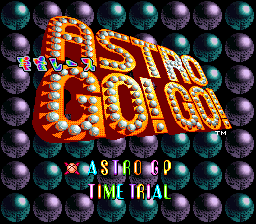
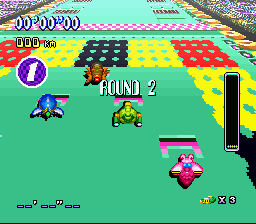
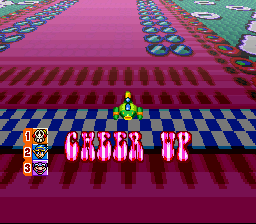
Retro Replay Review
Gameplay
The first few races make Astro Go! Go! seem straightforward: pick one of five vehicles, point it down the course, and try to finish ahead of the pack. Then the tracks begin demanding more than speed. Bottomless pits, acceleration fields, and jumps turn each lap into a question of timing and control, so a vehicle’s handling can matter as much as its maximum pace.
The vehicle selection is where the game earns some personality. You are not merely choosing a cosmetic ride; each machine has different strengths, including speed and manoeuvrability. If you like forcing the fastest option through dangerous courses, there is room to gamble. If a track keeps punishing loose control, switching to something more manageable is the sensible response rather than banging your head against the same mistake.
Grand Prix supplies the real pressure. It runs through 15 races, but you must place first, second, or third to see the next one. That rule makes every recovery meaningful and every bad finish costly. The automatic respawn after falling into a pit or getting stuck prevents a single mishap from ending a run outright, though it does not remove the sting of the time you have lost.
Time trial offers a cleaner test of whether the driving itself has clicked for you. Without Grand Prix placement hanging over each race, you can concentrate on finding safer approaches to jumps and better uses for acceleration fields. It is a good fit for anyone who enjoys repeated runs in pursuit of a tighter lap, while Grand Prix is for the mood when you want the game to push back.
Graphics
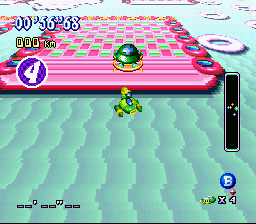
Astro Go! Go! uses a behind-the-vehicle camera that keeps the course directly in front of you. Its anime and manga styling, together with the futuristic racing setting, gives the cars and tracks a distinctly mid-1990s sci-fi flavor rather than aiming for realism.
The important sights are practical ones: pits that can swallow your vehicle, jump points, and acceleration fields. Since the courses make these hazards central to the race, learning to spot what is coming up is part of getting faster.

Story
Astro Go! Go! frames its momentum through competition rather than a plot-heavy campaign. You move through the Grand Prix one race at a time, and advancement comes from placing in the top three.
That gives the 15-race structure a clear competitive arc. A strong finish carries you onward; a weak one stops the climb. The stakes are simple, but they work because the game ties progress directly to your driving.
The sci-fi setting is there to color the races and the unusual vehicles, while the rivalry stays on the track. If you want a racing game whose sense of progress comes from meeting increasingly demanding placement goals, that directness is part of the charm.
Overall Experience
Astro Go! Go! is a focused arcade racer with sharper edges than its compact setup first suggests. It asks you to choose a vehicle intelligently, survive courses built around hazards, and repeatedly prove you can finish near the front. When the rhythm clicks, the next race feels earned rather than simply unlocked.
The one-player-only design is the biggest dividing line. You will not be passing controllers around for head-to-head races; this is a personal challenge built around your own route choices, control preference, and persistence. That focus suits the time-trial mode especially well.
At a 7, it lands as a worthwhile pick for gamers who enjoy old-school racing games that demand steady improvement instead of handing out progress. Give it a chance if jumps, boosts, vehicle trade-offs, and strict Grand Prix qualification sound motivating. Skip it if you mainly want multiplayer racing chaos or a relaxed cruise through every course.


Reviews
There are no reviews yet.