 Retro Replay Retro Replay gaming reviews, news, emulation, geek stuff and more!

Retro Replay Review
Gameplay
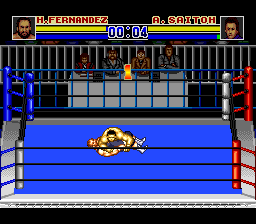
The first few minutes are easy to understand: pick a real New Japan wrestler, step into a side-view match, and start trading damage beneath familiar fighting-game-style health bars. That directness is Battlefield in Tokyo Dome’s strongest quality. You are not buried under a complicated season structure before getting to the ring; the game wants you in a singles or tag match quickly.
Battle mode is the obvious place to start if you are playing alone, since it lets you take one wrestler against computer-selected opposition. The cup gives those matches a knockout shape, while league mode is the better choice when you want results across several competitors to matter. Having both is important: a one-and-done bracket creates immediate pressure, whereas a league gives a small group a reason to keep returning.
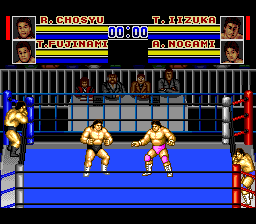
Versus is where the game’s simple setup has the most room to breathe. Being able to choose opponents directly is useful for settling arguments about matchups, and tag teams add another body to each side without changing the basic pick-up-and-play promise. League mode also supports up to four players, making this a more attractive cartridge for a local wrestling night than its plain battle format might initially suggest.
Frustration can set in if you come expecting the broader match variety or simulation-minded detail associated with later wrestling games. Battlefield in Tokyo Dome is centered on side-view fighting and health management, so its lasting pull rests on the roster, the competitive formats, and whether you enjoy replaying matches with friends. Give it a chance if that stripped-back arcade-minded approach sounds refreshing; otherwise, its modes may feel more like variations on the same core bout than radically different ways to play.
Graphics
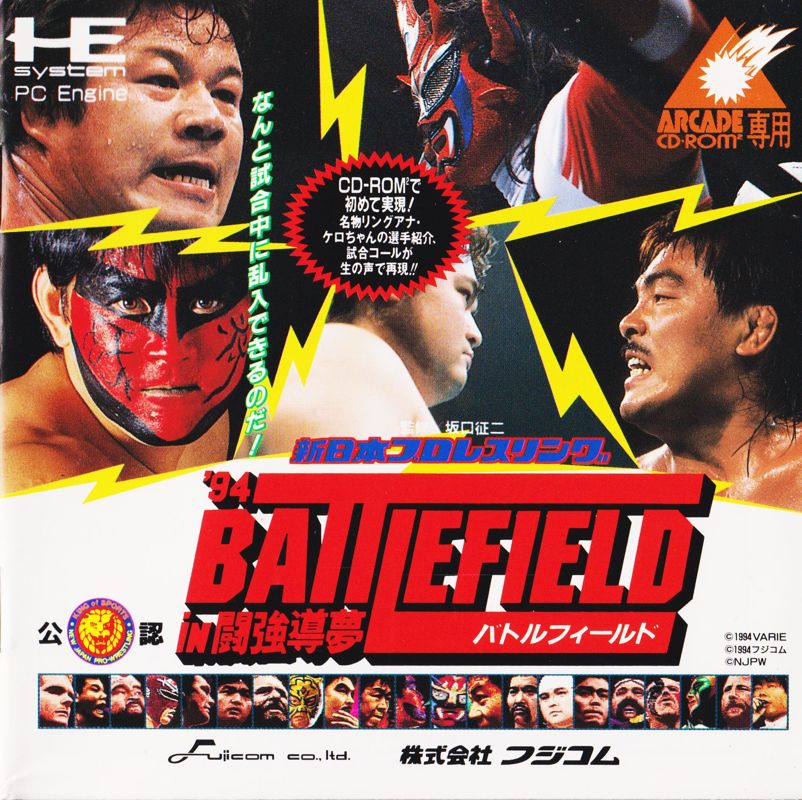
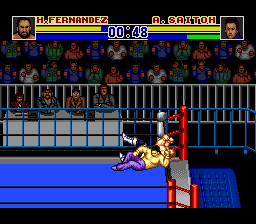
The game makes good use of its license at the edges of the action. Wrestlers appear as digitized photos in the introduction and on the character-select screens, then become 2D figures during matches. That contrast gives choosing a wrestler a pleasing period-specific authenticity, even if the bouts themselves shift to a more conventional 16-bit look.

Story
Rather than pushing a plot, Battlefield in Tokyo Dome lets the matches supply their own stakes. A battle run, a cup bracket, or a league table gives you a clear reason to care about the next opponent without asking you to follow a separate narrative.
The real hook is the New Japan Pro Wrestling license and its roster of real wrestlers from the period. If you have affection for that era, simply selecting familiar names and arranging singles or tag matchups carries more weight than it would in an invented wrestling lineup.
That makes the game’s “story” a personal one: who you choose, whom you put across the ring, and whether you can carry that choice through the format at hand. It is a modest frame, but it fits a game that puts competition first.
Overall Experience
Battlefield in Tokyo Dome is a compact licensed wrestling game with a sensible set of modes and an immediately legible side-view format. Its best moments are likely to come from a deliberately chosen versus match or a multi-player league, where the roster and format create just enough context for bragging rights.
Solo players still have battle mode and knockout cup play, but the game’s clearest advantage is flexibility rather than depth in any one mode. You can play a quick singles match, bring in tag partners, or turn the same basic action into a short tournament challenge. That is a solid foundation, even if it does not transform the core match into something new each time.
Recommended for fans of mid-1990s New Japan and anyone who enjoys old-school wrestling games that meet fighting games halfway. The payoff is not an elaborate wrestling simulation; it is the satisfying simplicity of picking a wrestler, picking a format, and seeing who comes out on top.


Reviews
There are no reviews yet.