 Retro Replay Retro Gaming History, Reviews & Emulation
Retro Replay Review
Gameplay
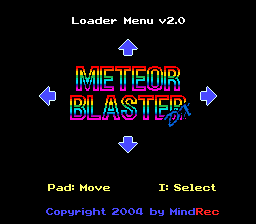
The first few minutes of Meteor Blaster DX are wonderfully direct. You choose a ship with its own speed and power balance, enter the arena, and start shaving huge asteroids into medium chunks, then small chunks, then finally dust. There is no long runway before the game asks for your attention. You are immediately judging distance, lining up shots, and trying not to let the screen become a dangerous cloud of spinning debris.
Rotating the cannon independently of the ship is the key detail. It gives you room to flee in one direction while firing in another, and it makes the four ship choices more than a cosmetic pick. A faster ship sounds comforting until you are overcorrecting around a cluster of splitting rocks; extra power may feel more useful when the field is crowded. That tension is where the shooter finds its groove.
Each stage uses the same screen, so the challenge comes from enemy mix and rising difficulty rather than a changing backdrop. Hostile UFOs that fire at you and boss fights help interrupt the pure asteroid-clearing routine, while temporary shields and other power-ups offer brief breathing room. Frustration can set in when a clean shot creates two new problems at once, but that chain reaction is central to the game’s bite rather than a flaw to be designed away.
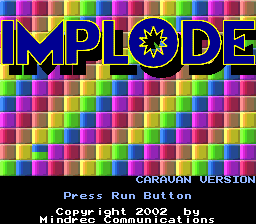
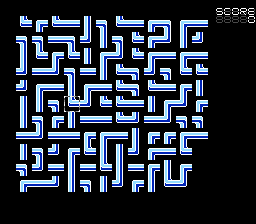
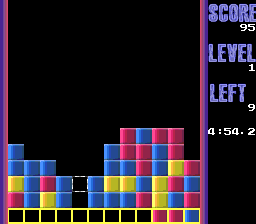
The extras make this a stronger package than a single-purpose Asteroids clone. Caravan Mode turns Implode into a timed test, while Loop asks you to rotate pipe pieces into closed loops before the board fills up. Neither changes what Meteor Blaster DX is at heart, but both are welcome alternatives when you want the same quick-session arcade mindset without another asteroid run.
Graphics
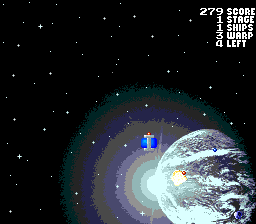
The action stays on a fixed space screen, with the ship, large and medium asteroids, their smaller split pieces, and UFO threats sharing the same combat area. That simple layout suits a game where you need to track several moving hazards at once, and the four selectable ships at least give your choice a visible presence on screen.
Story
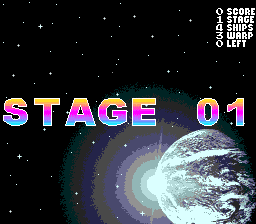
You play as Stryker, an astronaut sent into space to destroy dangerous asteroids. It is a functional arcade setup, and it wisely does not hold up the action with a larger plot.
That thin framing fits the mission structure. Clearing every rock is the goal, and each completed stage naturally reads as another successful sweep of the same threat. The UFOs and bosses add resistance without asking you to invest in narrative stakes the game is not built to explore.
If you need a shooter to carry you through a campaign of characters and revelations, this will feel bare. If a named pilot and a clear assignment are enough to put you in the cockpit, Stryker’s mission does its job and gets out of the way.
Overall Experience
Meteor Blaster DX is for the kind of night when you want to improve through repetition: learn how your chosen ship turns, control the fallout from every asteroid you split, and last a little longer against a busier screen. Its core loop is old-fashioned in the good sense—immediately understandable, increasingly tense, and easy to restart after a bad run.
The physical DX release earns its name by adding meaningful pressure to the original formula. UFO fire, bosses, power-ups, and a CD soundtrack give the shooter more texture, while Implode and Loop make the disc feel less slight between score attempts. The side games are a bonus, not the reason to buy in, but they reinforce the arcade-compilation spirit.
You should give it a chance if Asteroids-style precision still has a pull for you and you enjoy extracting mastery from a small set of rules. It will not convert anyone bored by fixed-screen arcade shooting, since its stages intentionally return to the same basic battlefield. For the right player, though, the payoff is a focused homebrew shooter with enough variations to keep that familiar asteroid dance sharp.


Reviews
There are no reviews yet.