 Retro Replay Retro Gaming History, Reviews & Emulation

Retro Replay Review
Gameplay
The first hour asks you to settle into an unusually talky version of Ranma 1/2. Rather than throwing punches, you guide Ranma through a menu-based adventure, picking verb commands such as Look and Talk and selecting objects from submenus. That makes the game feel closer to participating in an episode than controlling an action hero, which is either exactly the point or an immediate deal-breaker.
Its chapter structure is a smart fit for the license. Each section has its own theme and story while bringing back the same cast, so the game can move from one comic predicament to another without needing to pretend it is a single grand quest. The opening contest, where Ranma hopes a victory will get him to China and closer to curing his condition, gives the interaction a clear motive beyond simply touring familiar characters.
The friction comes from the format’s limits. Navigation is menu-based, and the core loop is choosing the right interaction rather than reacting in real time. If you came in hoping for the martial-arts energy associated with Ranma, this pace can feel slow. If you enjoy old-school adventures where progress comes from poking at conversations and objects, the format starts to click once you accept that the dialogue and situations are the reward.
Graphics
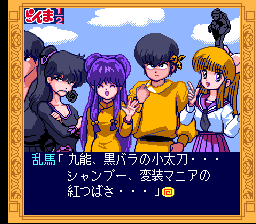
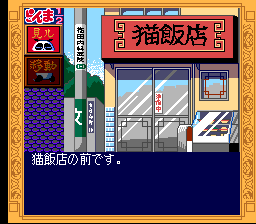
Frequent animated cutscenes are the visual draw here, giving the story room to move beyond its command menus. They are especially important because the game’s momentum comes from scenes and character exchanges rather than from action-heavy play.

Story
This is a character-driven comedy first. Ranma’s curse—cold water turning him into a woman and hot water changing him back—remains central, but the material also leans into his relationships with schoolmates and the other recurring faces around him. Romance, embarrassment, and absurd misunderstandings are the natural fuel for these chapters.
The episodic approach suits a series built on recurring complications. You are not being asked to absorb a dense original mythology before the game can get going; the basic setup is simple, and each chapter can focus on a fresh scenario. That makes it easy to enjoy in shorter stretches, much like watching individual television episodes.
Fans will get the most out of the tone because the game spends so much of its time on Ranma’s social orbit and his ongoing desire to remove the curse. Newcomers can follow the premise, but may find the slower adventure structure gives them fewer reasons to push through than someone already attached to these characters.
Overall Experience
Toraware no Hanayome is a specialized piece of Ranma entertainment, and it is better for not pretending otherwise. It turns the license into a digital comic: you investigate, talk, select, and then let the animated scenes deliver the next joke or complication. That is a more faithful use of this material than forcing every encounter into a brawl would have been.
Still, the payoff depends heavily on your patience for early-1990s menu adventures. There is little reason to recommend it to someone chasing a brisk, mechanically demanding game. The real hook is spending time with Ranma in a sequence of self-contained comic stories, with the player nudging each scene toward its next beat.
Give it a chance if you want an adventure built around the series’ romantic-comedy side and you are comfortable with deliberate, command-driven interaction. For committed fans, the chapter format and frequent cutscenes make it a worthwhile curiosity. For everyone else, it is an acquired taste: charming in concept, but far more interested in conversations and situations than momentum.


Reviews
There are no reviews yet.