 Retro Replay Retro Gaming History, Reviews & Emulation
Retro Replay Review
Gameplay
The first hour establishes a strong rhythm: Tokyo exploration and performer-focused side stories give way to trips into the Idolasphere, where the supernatural danger stops feeling like a distant excuse for the setting. You are not just passing through a themed version of Shibuya and Harajuku. The contrast between ordinary city spaces, career ambitions, and hostile otherworldly dungeons gives the adventure a pleasantly odd momentum.
Combat is where the game really locks in. Battles are turn-based, but simply picking the strongest-looking move is not enough. Strike an enemy weakness and a compatible ally can join the attack in a Session, turning one smart decision into a chain of follow-up hits. That makes elemental and weapon matchups feel immediate rather than like homework. When a Session starts rolling, you get the satisfying sense that your party is capitalizing on an opening instead of taking isolated turns.
The pressure runs both ways, which keeps that satisfaction from becoming complacency. Enemies can identify weaknesses too and launch Sessions of their own, so careless party choices can be punished quickly. That risk makes preparation and target selection matter, especially once you have become accustomed to chasing chains. Anyone hoping for Fire Emblem-style grid tactics should know this is a party RPG first, even with familiar faces in the mix. Chrom’s original game, Fire Emblem: Awakening, offers useful crossover context, but not a template for how these battles play.
Graphics
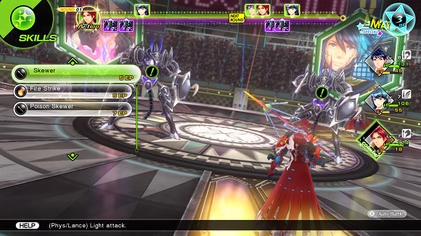
The isometric battle view turns fights into theatrical confrontations. A red-costumed fighter with long trailing fabric stands out against tall gray, lance-wielding armored enemies, while pale geometric designs cut across the dark circular floor. Pink-white effects flare behind enemies and colored rails frame a shadowy audience, giving the encounter the feel of a stage show invaded by fantasy combat.
That saturated color and costume work suits the entertainment angle nicely. At the same time, dark armor and the busy stage backdrop can compete for your eye in a crowded clash. The strongest images come from the bold contrast between the performers and the enemy ranks.
Story
Itsuki Aoi is drawn into the Idolasphere after following his childhood friend, Tsubasa Oribe, to an idol audition that goes catastrophically wrong. Their partnership with the benevolent Mirages Chrom and Caeda gives the story its crossover hook, but the larger focus remains on young people learning to pursue public-facing creative careers while a supernatural invasion feeds on Performa, or creative energy.
Fortuna Entertainment is a good frame for this material because it lets stage ambitions sit beside real danger without pretending they are unrelated. The performers’ goals matter to the story, and their side stories give the cast room to be more than a collection of fighters waiting for their next dungeon assignment. The tone is emphatically anime and knowingly melodramatic, yet it takes its characters’ drive seriously.
The original Wii U release’s Japanese voices and English text suit the Tokyo setting well. You need to be comfortable with a story that leans into idols, auditions, and show-business aspirations rather than treating them as a joke. If that sounds fun instead of distracting, the supernatural stakes have a much stronger emotional foundation. For Nintendo’s own overview of this Wii U edition, see Nintendo’s original Wii U game page.
Overall Experience
Tokyo Mirage Sessions ♯FE succeeds because it refuses to sand down its strangest idea. This is a JRPG about fighting an invasion with a cast of entertainers, and every major piece points back to that premise: the city setting, the character ambitions, the dramatic battle staging, and the joy of chaining a Session after finding a weakness.
Its biggest dividing line is obvious. If idol culture and high-energy anime sincerity make you roll your eyes, no amount of crisp turn-based strategy will completely change your mind. If you can meet it on its own terms, though, the game turns a potentially disposable crossover into a focused, energetic adventure with a combat system that rewards attention.
The payoff is worth it for JRPG fans who want personality alongside tactical decision-making. The Wii U version feels especially distinctive as its own thing, not a Fire Emblem tactics game wearing a Tokyo costume. Give it a chance if you want a stylishly earnest party RPG where knowing an enemy’s weakness can transform a routine turn into a full-team performance.


Reviews
There are no reviews yet.