 Retro Replay Retro Replay gaming reviews, news, emulation, geek stuff and more!

Retro Replay Review
Gameplay
Knights of the Chalice begins like a compact throwback to the era when entering a dungeon meant you were agreeing to pay attention. You form a party of four from Knights, Clerics, and Wizards, with Human, Half-elf, and Half-dwarf options, then set out across towns, towers, and dungeons built for exploration and tactical fights. The first hour’s pull comes from that familiar promise: a party-based fantasy campaign where a questionable corridor, a patrol, or a locked-off route can become a problem worth thinking through.
Combat is the center of gravity, and turn-based pacing gives you room to consider positioning and resources rather than simply scramble. Clerics use divine, healing-focused magic while Wizards bring arcane offensive spells, so party composition has practical consequences. This is a game for you if you enjoy making a plan before committing, then living with the result when that plan turns out to have a hole in it.
Equipment work is where Knights of the Chalice earns its own space among old-style RPGs. Instead of treating found or bought weapons and armor as fixed prizes, you can forge, enchant, upgrade, and rework them to suit your party and the challenge in front of you. That flexibility gives loot a longer life and makes preparation feel personal. If you love tuning a build, this system is likely to become the reason you keep pushing into one more dungeon.
Exploration has more to offer than marching from battle to battle. Secret doors invite careful searching, patrols can be evaded, and conversations may open alternate ways through a quest or out of a dangerous situation. The friction is intentional: players hoping for a breezy fantasy tour may find the old-school demands tiring, while anyone who enjoys poking at every option will find satisfying room to maneuver.

Graphics
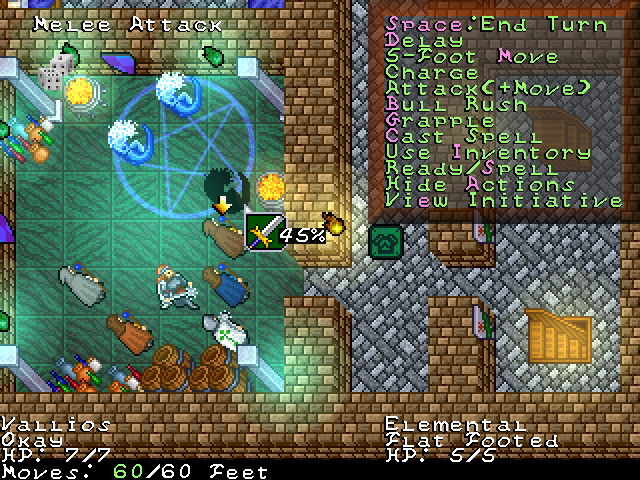
The game uses a retro 320×240 look, whether played in a window or full screen. Its top-down view fits the dungeon-crawling focus, keeping the party’s movement through towns, towers, and dungeon spaces straightforward to track. This is plainly a small-scale, old-school RPG picture rather than a lavish fantasy illustration.

Story
The story framework is direct: your four adventurers are sent into a fantasy world of layered towns, towers, and dungeons, with quests driving the journey onward. Knights of the Chalice puts its weight on what you do inside that framework—explore, fight, search, and decide how to handle trouble—rather than turning the campaign into a heavily voiced drama.
Conversations matter because they can change the route through a quest or offer a way to escape a tight spot. That gives the adventure some welcome flexibility. You are not always locked into solving a problem with the same fight, which helps the campaign feel more like a tabletop scenario than a string of mandatory battles.
There is no voice acting, so the writing and your own sense of party management carry the narrative side. Atmospheric music changes between locations and can shift within them, helping towns and dungeons feel distinct as you move through the campaign. Come for a practical fantasy adventure with choices at pressure points, not for elaborate character drama.
Overall Experience
Knights of the Chalice knows exactly which kind of RPG it wants to be: a tough-minded, turn-based dungeon adventure with recognizable D&D-style rules and a strong interest in player preparation. It does not rush to flatter you. You will get more from it by slowing down, checking for secrets, considering patrols, and treating equipment as a toolkit instead of a pile of vendor trash.
Its payoff is strongest when a difficult situation starts to click because of decisions you made earlier—choosing a party mix, holding the right spells in reserve, or modifying a piece of gear for the job. The crafting and upgrading system is more than a side attraction; it gives the campaign a satisfying sense that your party’s tools are genuinely yours.
Give it a chance if tactical combat, dungeon exploration, and old-school RPG discipline sound inviting. Skip it if you need fast pacing, modern-scale visuals, or a story led by voice performances. For the right gamer, this is a focused indie homage with enough customization and quest flexibility to be more than a nostalgia exercise.


Reviews
There are no reviews yet.