 Retro Replay Retro Replay gaming reviews, news, emulation, geek stuff and more!
Retro Replay Review
Gameplay
PCTris 3D earns its name immediately: instead of arranging pieces across a flat playfield, you are dropping them into a three-dimensional well and trying to fill an entire horizontal plane. That one change makes the opening minutes both familiar and disorienting. You know the basic falling-block instinct—find a home, turn the piece, get it down—but depth makes every decision harder to trust.
The three-axis rotation is where the game either hooks you or loses you. Arrow keys combined with Shift or Control let you turn a block around any axis, and the first real hurdle is building the mental picture needed to use that freedom well. A piece that looks harmless from above can create an awkward cavity underneath, while a careful rotation can seal off a whole layer cleanly. It asks for deliberation rather than panic, even though pieces are still falling in real time.
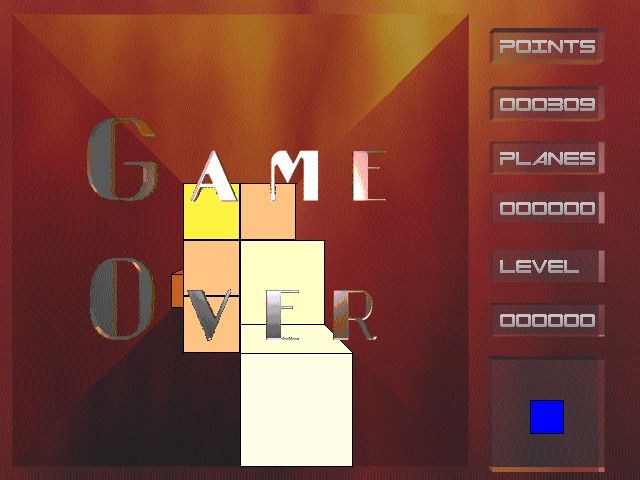
Clearing a completed plane and watching everything above drop is the reward for that discipline. It gives each placement more weight than it has in a standard two-dimensional falling-block game: you are not only aiming for an immediate line clear, but trying not to poison the structure you will inherit after the collapse. The score, completed-plane count, and level counter make progress easy to track, while the top-view preview is a genuinely useful aid rather than decoration.
Frustration sets in when your sense of the well’s interior lags behind the piece in your hands. This is a game that asks you to recover from imperfect placements, and it can feel unforgiving if you prefer quick visual certainty. Still, the learning curve has a satisfying edge. Once rotations start to feel less like guesswork, PCTris 3D becomes a compact test of planning, orientation, and nerve.
Graphics
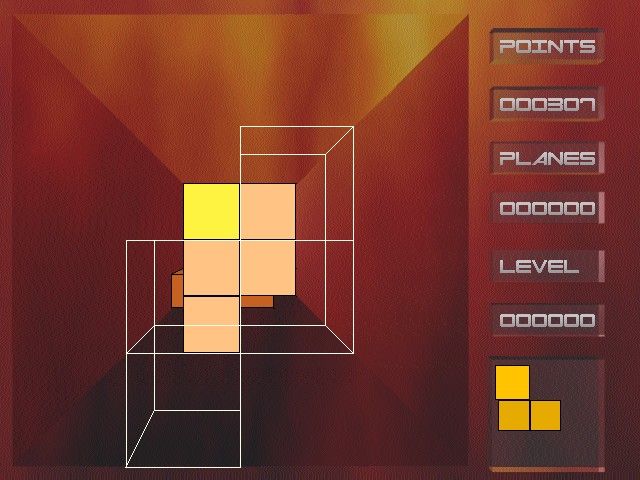
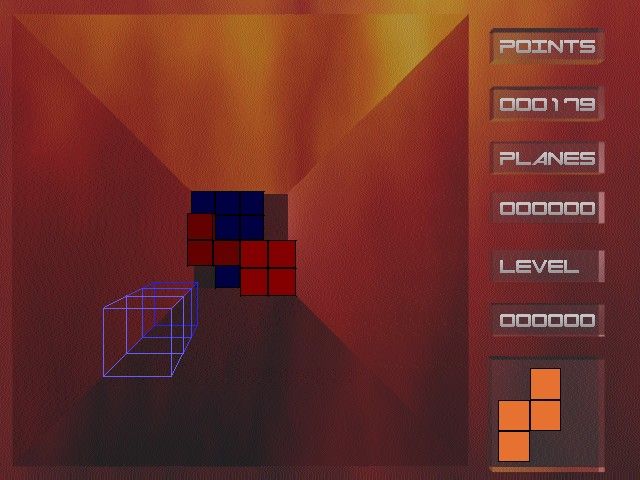
The central view is a 3D well full of descending blocks, with completed layers distinguished by color so you can judge their height and placement more easily. The active block stays as an outline until it is set in the well, which helps separate the piece you are handling from the stack you have already built.
A side pane keeps the score, planes completed, level, and a top-down image of the current block together. It is a plain arrangement, but the top view matters when you are trying to understand a shape before committing it to the pile.

Story
PCTris 3D finds its drama in the stack rather than in characters or plot. Each level begins as open space and gradually becomes a record of your good decisions, rushed turns, and near-misses.
The small story of a session is whether you can turn a messy construction back into orderly planes before the next pieces make it worse. A cleanly completed layer feels like a chapter closed; a hidden hole feels like trouble postponed.
That stripped-back focus suits the game. You are here to read shapes, manage space, and see whether your plan survives the pressure of the next block.
Overall Experience
PCTris 3D is a thoughtful variation on falling-block puzzles, not because it buries the formula under extra rules, but because depth changes the meaning of every familiar rule. The moment you understand that you must manage the unseen spaces inside the pile—not just its surface—the game starts asking more interesting questions.
Give it a chance if you enjoy puzzle games that reward spatial visualization and patient improvement. The network option also makes sense for a game whose simple objective is easy to grasp but difficult to master. You will know quickly whether the three-dimensional well feels exciting or exhausting, but for the right kind of puzzle fan, that struggle is the payoff.
It is not the breezy pick for someone who only wants the instant clarity of a flat board. It is, however, a worthwhile challenge if rotating a shape in your head sounds like an invitation rather than homework. PCTris 3D takes a known idea and makes you earn your confidence one completed plane at a time.


Reviews
There are no reviews yet.