 Retro Replay Retro Gaming History, Reviews & Emulation


Retro Replay Review
Gameplay
The good news is that Smok Wawelski gives you a goal with immediate weight. A dragon is demanding young maidens as sacrifices, and you are not a knight or a chosen hero but Skuba, an apprentice cobbler who has to solve the problem with nerve and practical ingenuity. That makes wandering through the town and its surrounding landscape feel purposeful from the outset: you are hunting for a way to turn an impossible threat into a workable plan.
This is firmly a command-driven adventure. You collect objects, carry them to appropriate locations, and type what you want Skuba to do. The parser’s ability to accept full sentences in different syntactic forms is a meaningful strength for its era. It invites you to phrase an action naturally rather than forcing every thought into a tiny handful of rigid commands. Support for Polish diacritical marks also makes the input feel built for the language of its legend rather than merely adapted to it.
That freedom comes with the classic text-adventure bargain. Progress hinges on connecting objects, places, and the eventual preparation of sulfur-stuffed sheep, so you need to enjoy testing possibilities and revisiting what you have found. The satisfaction is in arriving at the intended solution yourself, not in speed or spectacle. Anyone comfortable with deliberate, language-led puzzle solving will get more from it than someone who wants constant forward momentum.
Graphics
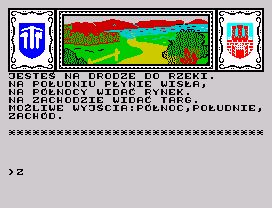
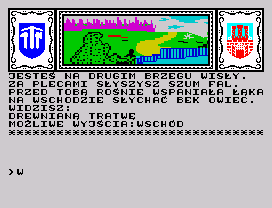
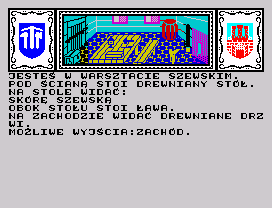
Colorful, detailed graphics accompany the text, giving the Wawel dragon tale more character than a purely text-only adventure. They are a welcome counterpoint to the typed commands, putting a visual face on Skuba’s journey through the town and surrounding landscape.
Story
The game has the advantage of beginning with a legend that already knows how to hold attention. The Dragon of Wawel Hill is not simply a generic fantasy monster here: its demand for sacrifices gives Skuba’s task a clear moral urgency, while his humble trade makes the coming solution feel clever rather than heroic in the usual sense.
Skuba is a strong fit for this kind of adventure because he is an underdog. A cobbler’s apprentice has no obvious reason to triumph over an evil dragon, which turns every useful discovery into part of a believable folk-tale escalation. You are not being asked to conquer the creature through force; you are trying to find the one practical answer that can work.
The sulfur-stuffed sheep is the story’s memorable centerpiece. It is wonderfully strange, specific folklore logic—the kind of solution that could only emerge from a tale passed along for generations. That gives the game a more distinct flavor than a standard hunt for a magic weapon.
Overall Experience
Smok Wawelski is worth your time if the phrase “Polish folklore text adventure” sounds more inviting than intimidating. Its setting and protagonist give it personality immediately, and the central dragon problem has a satisfying riddle-like shape. The colorful illustrations help keep the journey from becoming a wall of commands.
Its biggest hurdle is also inseparable from its charm: this is an adventure played through written language. You have to be willing to stop, think through an object’s possible use, and express an idea to the parser. Familiarity with Polish matters especially, since the game recognizes Polish diacritics and accommodates varied sentence construction.
For a gamer willing to meet it on those terms, this is a nicely focused trip through a famous legend rather than a sprawling fantasy epic. The payoff is the pleasure of helping an unlikely hero engineer a very particular answer to a very old monster problem. It is more niche than universally approachable, but far more memorable than its simple premise first suggests.



Reviews
There are no reviews yet.