 Retro Replay Retro Replay gaming reviews, news, emulation, geek stuff and more!


Retro Replay Review
Gameplay
The opening turns of Arnhem have a compelling nervousness to them. You place airborne units across clear landing areas, wait for them to come down, then begin the hard work of turning scattered forces into a coherent advance. That delay matters. You are not simply marching pieces toward Arnhem; you are trying to establish momentum before the German defense can make the operation unravel.
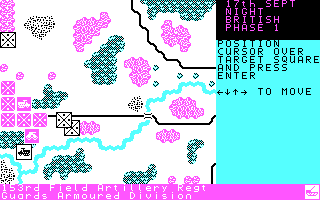
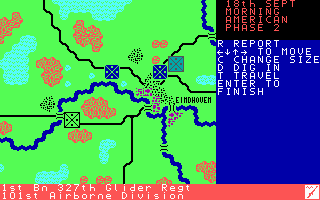
Once units are on the ground, the command set is straightforward: move across rectangular grid cells, dig in, alter unit size, and use bombardment where the unit permits it. The simplicity is a strength if you enjoy classic turn-based wargames. There is little distance between looking at the map and making a decision, whether that means driving forward, securing a position, or slowing down long enough to prepare for resistance.
Frustration can set in if you want a quick, cinematic version of Market Garden. Arnhem asks for deliberate planning and accepts that a turn can hinge on positioning, timing, and the awkward reality of getting dispersed troops where they need to be. Start with one of the smaller scenarios, such as the advance to Eindhoven, before taking on the entire campaign. The full operation will mean more once you understand how quickly a promising advance can become a defensive problem.
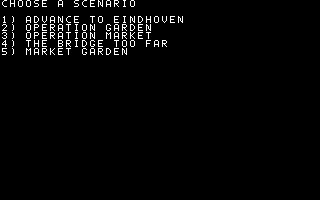
The five-scenario structure is one of the game’s better decisions. Operation Garden, Operation Market, The Bridge Too Far, and the complete campaign let you approach the battle at different scales, while the Allied and Axis sides can each be run by a computer or another human. Facing a human opponent should bring out the tension in every attempt to hold ground or force a route forward.
Graphics
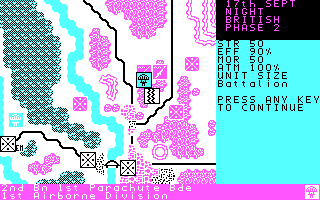
The action is shown on a scrolling overhead map divided into rectangular cells, with units moving across it turn by turn. It is functional battlefield viewing rather than decorative war imagery, but the map format fits a game built around plotting routes, landing troops, and judging where a defense might hold.
Story
Arnhem draws its drama from a real operation rather than from invented characters or plot twists. Allied forces are attempting to seize the bridge at Arnhem in the Netherlands during September 1944, with British, Irish, Welsh, Polish, and American units facing German forces. You know from the outset that history ended badly for the Allies, which makes the chance to change that outcome the central hook.
That historical framework gives the campaign more bite than a generic World War II map battle. The names of the scenarios point toward the operation’s separate moving parts—Garden, Market, the advance to Eindhoven—and then toward the bridge that became the defining objective. Even without a character-driven narrative, there is a clear sense of a large plan under strain.
The included historical notes, maps, and photographs are especially valuable for a game of this vintage. They encourage you to see the operation as more than a set of abstract turns, and they give context to the difficult task the Allied side is trying to pull off. If you already know Market Garden, that context deepens the what-if appeal; if you do not, it gives the conflict a useful entry point.
Overall Experience
Arnhem is an earnest, demanding historical wargame whose strongest moments come from the gap between the plan and the battlefield. A route that looks sensible can become precarious when units land apart, defenders resist, and time starts to work against you. That is exactly the kind of pressure Market Garden needs to feel like more than a list of objectives.
Its age shows in the plain, map-led approach and in the patience it demands. You need to enjoy thinking in turns, grid positions, and cautious commitments. If your idea of a World War II game is immediate action, Arnhem will feel dry; if you enjoy sitting with a difficult operational decision, its directness can be refreshing.
The payoff is worth pursuing for strategy fans with an interest in the campaign. The smaller scenarios offer a sensible way in, while the full campaign supplies the larger historical challenge: can your Allied force achieve what the real operation could not? Arnhem does not romanticize that question. It makes you work through it, one tense movement order at a time.


Reviews
There are no reviews yet.