 Retro Replay Retro Replay gaming reviews, news, emulation, geek stuff and more!
Retro Replay Review
Gameplay
The first few turns are immediately understandable: hold dilemma cards, pick somebody to answer one, and hope their yes-or-no response matches the answer card in your hand. A match clears both cards, bringing you closer to emptying your hand. It is a pleasingly lean setup, and there is a real little thrill in choosing the friend whose principles—or lack of them—you think you can predict.
What makes the game more than a guessing exercise is the challenge. Miss the match and the other participants decide whether the responder was true to their established character. That turns a wrong prediction into a small courtroom argument, where knowing how someone presented their personality before the game can matter as much as knowing their opinions. Winning lets you pass a dilemma card to the loser, so a well-timed challenge can reverse a bad turn.
The limitation is equally clear: every decision runs through binary answers and a small loop of prediction, challenge, and voting. Against computer-controlled opponents, pre-determined personalities give you targets to learn, but they cannot replace the unpredictable pleasure of a room full of humans defending themselves. Three to ten participants is a generous range, yet the game earns its time only if the group is willing to talk, tease, and make judgments rather than rush through cards.
Graphics
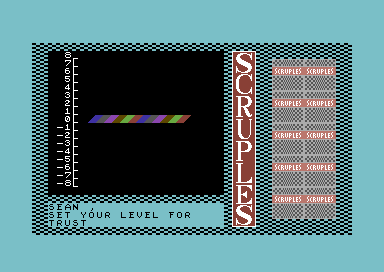
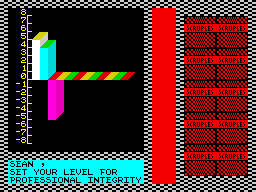
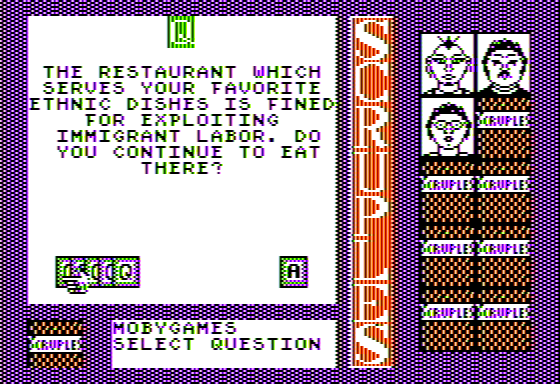
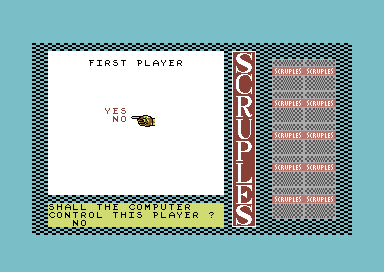
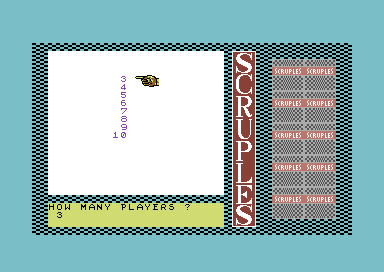
Graphics are strictly functional. You see the dilemma text, your cards, and chosen face pictures for the other participants. The faces help you track who is being put on the spot, but this is essentially a board-game table translated into a text-and-card screen.
Story
There is no authored plot to carry you from one round to the next. Instead, each dilemma creates a tiny social story: someone gives an answer, someone else claims it does not fit, and the table decides who is bluffing or who has revealed an inconsistency.
That structure can make an ordinary question surprisingly revealing. The personalities set before play give the voting a shared reference point, while the dilemma cards invite everyone to test it. Your group supplies the tone, whether that means thoughtful debate or gleeful accusations.
The downside is that the game has no narrative momentum beyond the cards leaving your hand. If the questions do not spark conversation among your particular group, there is nothing else waiting in the wings to create drama. Its stories are only as good as the people answering.
Overall Experience
A Question of Scruples is a social game first and a strategy game second. Its strategy is real but narrow: study personalities, choose the most predictable opponent, and use challenges to punish answers that do not ring true. The rules never get in the way, which is valuable when several people are taking turns around one computer.
Its 6.2 score feels fair. The conversion captures the central board-game dynamic, but the stripped-down visuals and repetitive yes-or-no rhythm leave it with limited solo appeal. Computer opponents can fill seats, not recreate the tension of trying to catch a friend contradicting their own stated values.
Give it a chance if you want a low-pressure party game built around moral hypotheticals and group banter. Skip it if you need deep tactical variety, a story campaign, or much to engage with between rounds. With the right crowd, its simple accusations and predictions can still land; without one, it is a very bare game of cards and text.



Reviews
There are no reviews yet.