 Retro Replay Retro Gaming History, Reviews & Emulation
Retro Replay Review
Gameplay
Guadalcanal begins with a pleasingly daunting kind of command. You are not simply pushing land units around an island; you are trying to coordinate air, land, and naval forces in a campaign where carriers, transport ships, patrol seaplanes, and scouts all have a reason to exist. The first hour has the nervous energy of a real operational puzzle: commit too much too soon, neglect your sea lanes, or fail to learn what the enemy is doing, and your larger plan can come apart.
Supply is the game’s sharpest hook. Transport ships are not background bookkeeping, because getting men and material where they need to go determines whether you can keep fighting. That emphasis gives naval decisions weight and stops the land battle from becoming a detached board-game contest. The dual American and Japanese campaigns also suit the subject well, letting you tackle the same long struggle from opposing strategic positions.
Weather and morale already make for familiar wargame complications, but malaria is the detail that gives Guadalcanal its particular bite. Troops slowly wearing down adds another clock to the campaign, so waiting safely is not always actually safe. It is an effective way to make attrition feel like part of the battlefield rather than a number you glance at between attacks.
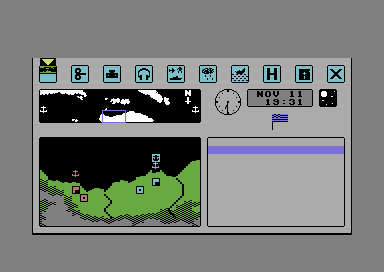
The friction comes from the interface. Guadalcanal uses icons alongside a strategic map, a zoomed tactical map, and a unit-details window, which gives you the information needed for serious command but can make the game feel demanding before its rhythm clicks. Stick with it if you enjoy studying a situation and making careful commitments. If you want fast, clean tactical gratification, its layered responsibilities may feel more like work than war-gaming drama.
Graphics
The view is built around a strategic map, a closer tactical map, and a unit-details window. That split is practical for a game handling air, land, and naval forces at once: you can step back to consider the campaign or move in closer when the local situation matters.

Story
This is a historical campaign rather than a character-driven war story, and that is the right fit. Guadalcanal starts in August 1942 after the US Marines seize the strategically important island, then asks you to manage the six-month fight as Japan attempts to take it back. The stakes arrive through the situation itself: holding or retaking one island becomes a prolonged test of planning and endurance.
Choosing either the American or Japanese side gives the conflict more than one angle. You are not watching the campaign from a fixed victorious perspective; you are responsible for pursuing each side’s military aims under the same harsh conditions. That helps the subject feel less like a history lesson and more like a contest of competing operational priorities.
The strongest narrative thread comes from attrition. Supply concerns, intelligence work, morale, weather, and malaria make the campaign feel prolonged in the way a Guadalcanal game ought to: success is not a single bold move, but the ability to keep a force functioning over time. Do not come here for scripted drama. Come for the accumulating pressure of a difficult historical operation.
Overall Experience
Guadalcanal has the good kind of old-wargame ambition. It treats the battle as an interconnected air, sea, and land problem, and it refuses to let combat exist separately from scouting, shipping, or troop condition. When your plans begin to account for all of those pressures, the game’s complexity starts to feel purposeful rather than merely dense.
It is not the easiest recommendation for a newcomer, largely because the icon-driven, multi-window command structure asks you to meet it on its own terms. There is little room here for casual improvisation; the game rewards attention, patience, and an interest in logistics. That can be frustrating when you want immediate feedback, but it is also where its best moments come from.
For a gamer drawn to World War II strategy and willing to wrestle with a 1987 interface, Guadalcanal is worth a look. Its systems create genuine tension, particularly the combination of supply and malaria, even if the execution can feel cumbersome. It earns respect more readily than affection, but the payoff is a campaign that understands why this battle was hard to win and even harder to sustain.


Reviews
There are no reviews yet.