 Retro Replay Retro Replay gaming reviews, news, emulation, geek stuff and more!
Retro Replay Review
Gameplay
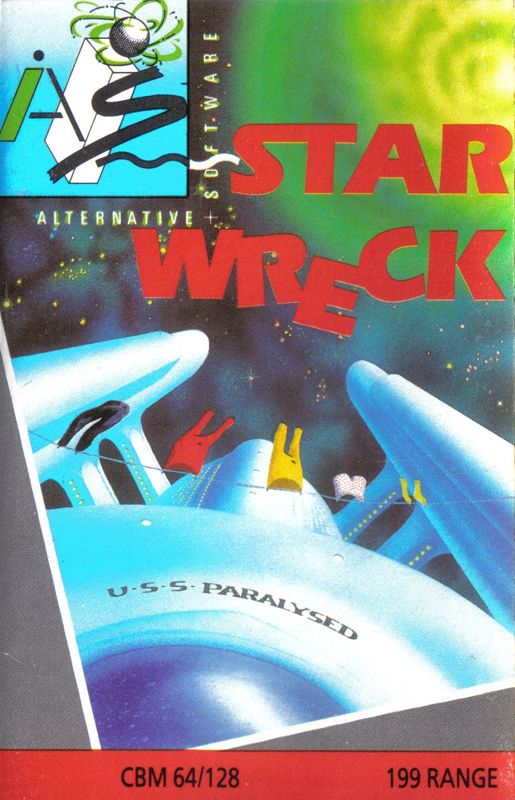
The first hour of Star Wreck has a pleasingly scrappy pull. You are Captain James T. Cake, commander of the Paralysed, and even the names tell you exactly how seriously this adventure takes its spacefaring mission. Your stated job is simple enough—deliver a Trell and a Rigellian Slime beast to Dandrox—but the ship starts coming apart around you. That turns a delivery run into a chain of repair-oriented puzzles, with passengers and cargo adding to the sense that your vessel is one bad command away from becoming a disaster.
This is a keyboard-controlled text adventure through and through. You type instructions, parse the responses, examine the situation, and try to connect an object or command with the next obstacle. Star Wreck’s parser advertises more than a hundred words, and its willingness to include verbs like ENERGISE, TASTE, STROKE, KISS, and REVERSE gives you permission to be mischievous. Try the obvious command first, certainly, but the game is built for the moment when you decide the obvious answer is too sensible for this particular ship.
That same old-school freedom is where frustration can settle in. A broad vocabulary sounds inviting, but it also means you can spend time cycling through possibilities when the puzzle solution is not clear. The game’s humor helps soften failed experiments, yet it cannot fully remove the stop-start rhythm familiar from 1980s parser adventures. You need patience, a willingness to test strange ideas, and a tolerance for being stuck before the next breakthrough feels earned.
There is a decent comic engine beneath the trial and error. The mission becomes more entertaining as problems aboard the Paralysed pile up, because every malfunction is another excuse for the game to make its captain look less like a heroic space commander. If you want fast pacing or carefully guided puzzles, this will feel creaky. If you enjoy poking at a compact interactive-fiction world until its absurd logic finally yields, Star Wreck can still raise a grin.
Graphics
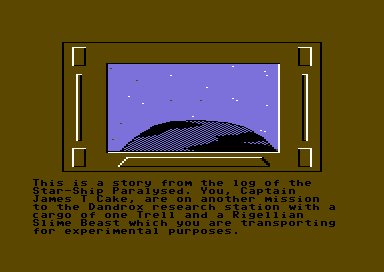
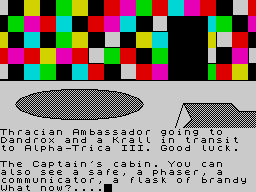
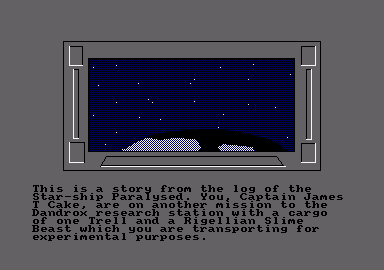
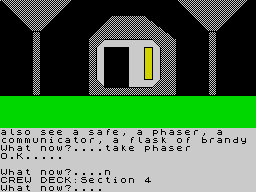
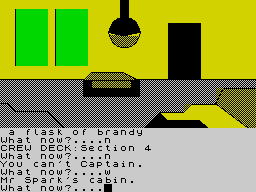
Star Wreck combines its command-line adventure format with graphics, using a first-person, fixed-screen view rather than asking you to imagine every location from text alone. On Commodore 64, ZX Spectrum, and Amstrad CPC, the visuals give the shipbound setting a little extra shape between typed commands, though the interaction remains firmly centered on the keyboard and the written responses.
Story
The plot is knowingly ridiculous from the opening assignment. Captain Cake must transport two creatures needed for experiments on Dandrox, while a Thracian ambassador is also bound for the planet and a Krall is merely passing through. It has the shape of a classic television space mission, then fills that shape with names and circumstances that refuse to behave with dignity.
The story works best as a framework for jokes and escalating ship trouble, not as a dramatic sci-fi saga. You are not being asked to carry the weight of a galaxy; you are trying to reach a destination while your own starship increasingly undermines the plan. That makes the goal easy to understand and gives the puzzles a sensible place in the journey.
The parody is broad, but it is appropriately broad. Star Wreck understands that malfunctioning spacecraft, strange passengers, and a captain saddled with an absurd cargo manifest are fertile material for comedy. Fans of Trek-style space adventure who can laugh at the genre rather than demand a faithful simulation will get the most from its tone.
Overall Experience
Star Wreck is a modest but likable relic of text-adventure design: funny premise, serviceable journey, and puzzles that ask you to meet it on its own stubborn terms. The central gag never needs much explaining. You are in charge of the Paralysed, and keeping it functional is naturally more difficult than the official mission briefing suggests.
Its biggest weakness is also inseparable from its period charm. Typing commands and probing a large parser can make you feel clever when an unusual verb solves a problem; it can also make you feel as if you are negotiating with the game’s vocabulary rather than solving the situation in front of you. That trade-off is hard to ignore, especially once progress slows.
Give it a chance if you have affection for Spectrum, C64, or CPC adventures and want a light sci-fi parody with a few eccentric commands to try. Skip it if you need polished guidance, brisk momentum, or puzzles that always make their logic plain. For the patient retro adventurer, the payoff is not grandeur—it is the small satisfaction of coaxing a deeply unserious starship toward its destination.


Reviews
There are no reviews yet.