 Retro Replay Retro Gaming History, Reviews & Emulation
Retro Replay Review
Gameplay
The first few minutes of Controller are deceptive. You see eight aircraft listed beside a radar sweep, choose one to manage, and it seems like issuing headings, altitude, and speed changes should be simple enough. Then the scope starts filling with traffic. Aircraft you have not selected remain in the air as obstacles, the landing field sits only three miles from the center of the sweep, and every decision has to respect 1,000 feet of vertical separation. You are not merely steering dots toward an airport; you are building safe approach paths while trying not to paint yourself into a corner.
The limitation that makes it interesting is also what makes it hard: you can view precise location and fuel information for only one plane at a time. Aircraft type is another detail you must remember or write down. That turns a routine sequence of commands into an attention-management exercise. A small prop plane can turn more comfortably and sips fuel, but its limited tank leaves little room to undo a mistake. Larger jets carry more fuel yet need room and time to settle onto an approach. Keeping a pad beside you is not optional busywork here; it is the sensible way to stay ahead of the traffic.
Controller rewards planning over panic. The adjustable radar range, from 100 to 10 miles, matters because a large aircraft needs to be lined up before it gets close. Wait until a jet is filling the small scope and you may already be watching it fly past the field. The landing sequence has a satisfying strictness: reduce speed, descend to 1,000 feet, and put the aircraft into the approach path. At that point the pilot can take it home. The trick is recognizing that a bearing aimed directly at the runway is not automatically a safe approach, and that landing two planes at once is inviting disaster.
Frustration arrives when you lose track of the details the game deliberately withholds until you call up an individual plane. This is not a relaxed management game and it does not cushion bad prioritization. But that harshness gives a successful run its payoff. When you have separated a mixed batch of traffic, set up the approaches early, and watched the planes clear without creating a conflict, you feel like you actually managed a crowded piece of airspace rather than simply completed a checklist.
Graphics
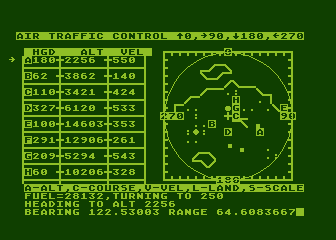
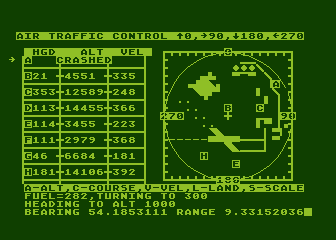
The radar-green screen is spare but appropriate: a circular sweep occupies one side while the list of eight inbound planes sits alongside it. The view keeps headings, velocity, and altitude in sight, so the important information is close at hand while the moving traffic remains the focus.
It is an austere early-1980s computer display, closer to working with a radar console than watching aircraft in motion. The plain screen suits the game’s concentration-heavy pace, though it offers little visual relief once the arithmetic and route planning start to pile up.
Story
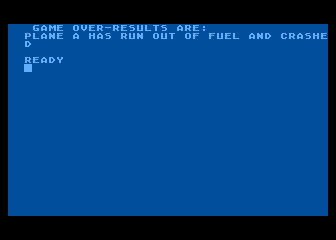
Controller does not lean on characters or a plotted campaign. Its drama comes from the job itself: a handful of aircraft, a limited radar picture, and the responsibility of getting them down safely. That narrow setup is enough to create its own little stories of decisions made early, trouble noticed late, and approaches salvaged just before they become costly.
Each plane brings a different kind of tension. A forgiving prop aircraft can still become a problem when its small fuel supply makes repeated corrections expensive, while a jet asks you to think further ahead because its wider turning needs shape the rest of the traffic. You end up assigning personalities to callsigns through their constraints, even though the game’s real subject is procedure and pressure rather than character drama.
The period fascination with air traffic control comes through in the fantasy of competent command. Controller puts you in the seat where calm foresight matters more than bravado. Its most memorable moments are not scripted twists; they are the quiet relief of realizing a difficult approach is finally stable, followed by the dread of noticing another aircraft still needs somewhere to go.
Overall Experience
Controller is a focused, unforgiving simulation that understands why air traffic control is compelling: simple instructions create complicated consequences when several aircraft need the same patch of sky. The interface may be minimal, but the decisions are not. It asks you to calculate, remember, prioritize, and accept that the right move for one aircraft can make the next one harder to handle.
You should give it a chance if old-school simulations appeal to you because they demand active note-taking and concentration, not because they imitate modern convenience. The game’s strongest quality is the way its constraints force genuine route planning. It is easy to understand what each command means; it is much harder to issue those commands in the right order with enough distance left to recover.
It will be a rough fit if you want a smooth onboarding or a forgiving sandbox. Controller expects you to learn through pressure, and its one-plane-at-a-time information checks can feel deliberately awkward. Yet that friction is tied directly to its tension. The best way to enjoy it is to start conservatively, work traffic well before the airport, keep written notes on aircraft types, and treat fuel as a deadline rather than an afterthought.
For the right kind of strategy fan, the payoff is real. Controller turns a small list of incoming flights and a green radar circle into a compact puzzle of spacing, timing, and nerve. It is less about flashy aviation and more about the satisfaction of making a complicated landing sequence look orderly when it absolutely was not.


Reviews
There are no reviews yet.