 Retro Replay Retro Gaming History, Reviews & Emulation


Retro Replay Review
Gameplay
The first race teaches Stakes Winner’s central lesson quickly: being fast is not the same thing as racing well. You pick from horses with different speed, stamina, and strength ratings, then try to nurse that choice through an eight-horse field. The reins offer modest acceleration for a modest energy cost; the whip delivers the thrilling, dangerous option. Hit it at the right moment and you surge past a rival. Lean on it too early and your exhausted horse has to back off while the race keeps moving.
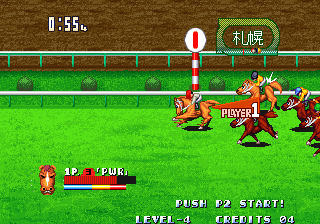
That push-and-pull gives the game its bite. You are watching position on the course map, judging the traffic in front of you, and deciding whether a passing move justifies the power it costs. Quick directional inputs let you shove a blocking rival aside or sharply slow down, so crowding matters instead of being mere background chaos. Pickups add small swings during a race, whether they temporarily raise an attribute, restore some energy, or grant extra speed. Drizzle also makes the going worse, an extra wrinkle that can punish a careless pace.
The career structure keeps asking you to improve rather than simply repeat the same sprint. Tracks get longer, purses rise for the top three finishers, and training breaks separate groups of races. Dirt and turf training can build stamina and speed, while hill training strengthens the horse. The catch is that training success comes from rapidly pressing a button while avoiding hazards, and that can feel more like a demanding arcade chore than satisfying conditioning. Still, choosing which stat to raise gives your run a little ownership, and advancing by placing in the top three makes the console version less brutally all-or-nothing than an arcade-style progression system could be.

Graphics
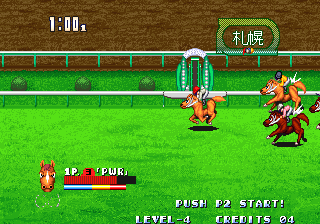
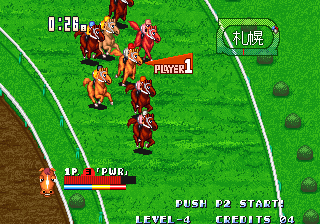
The race screen puts useful information right in front of you: a course diagram with colored position markers, a running clock, the energy bar, and a horse-face portrait that changes with fatigue and effort. The track map is especially handy because it lets you see the field’s shape while you decide whether to spend power for a move.
Horse names lend the lineup some old arcade character. Your choices include White Heat, Hot Sand, Brave Lady, and Sky Dancer, while rivals can arrive with names such as Mr Devious, HelpMe, OhMygod, and Nutseater. It is a small detail, but it makes each crowded race feel a touch less anonymous.
Story
There is no dramatic tale to carry Stakes Winner; its story is the climb through a racing calendar. You begin around juvenile events, work through major stakes, and keep returning to tougher versions of races as the schedule builds toward the late-game cups and The Arc.
That straightforward structure suits the game’s arcade instincts. Instead of stopping for character scenes or elaborate detours, it turns each event into another test of whether your horse’s attributes and your pacing decisions are good enough for the next prize. The escalating prize money gives the run a clear sense of forward motion, even if money itself is more of a marker of achievement than the point.
The horse selection does most of the personality work. Brave Lady stands out as the only female option, and the differing star ratings quietly encourage you to form preferences: take a quicker horse for immediate confidence, or favor stamina and try to win with patience. It is minimal framing, but it gives repeated attempts a satisfying sporting rhythm.
Overall Experience
Stakes Winner is at its best when you are sitting just off the leaders with enough energy for one decisive move. It makes restraint exciting, then rewards you for recognizing the instant when restraint has to end. That is a strong foundation for an arcade racer, and it remains engaging because the decision is never entirely safe.
Its limitations are equally clear. Training’s button-mashing can wear out its welcome, and the old arcade structure asks you to learn through failure, especially as races become harder. Four difficulty settings give you a sensible way to find a starting point, though, and the top-three advancement rule keeps a good run from collapsing over one imperfect finish.
Give it a chance if you want a focused, fast horse-racing game rather than a detailed stable-management simulation. The controls are easy to understand, but the energy economy, traffic, weather, pickups, horse stats, and training choices leave enough room to improve. It is a compact arcade contest with a surprisingly tense finish-line kick. For release and series background, see the Stakes Winner history.


Reviews
There are no reviews yet.