 Retro Replay Retro Replay gaming reviews, news, emulation, geek stuff and more!
Retro Replay Review
Gameplay
Adarod starts from an easy-to-grasp goal: get your four pieces off the board while piling up as many points as you can. That sounds tidy, but the board quickly turns it into a contest of nerve. Some spaces simply remove a piece, while others turn removal into a scoring opportunity, and the difference between getting there first or last can matter a great deal.
The two-field scoring tiles are where the game finds its bite. More pieces landing on one raise the points on offer, meaning you may want opponents to feed a tile before you claim it yourself. That creates a satisfying bit of brinkmanship: wait too long and somebody else takes the best reward; move too early and you settle for less. It is a small rule with enough tension to make ordinary movement feel consequential.
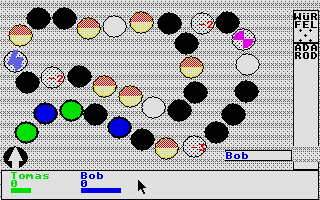
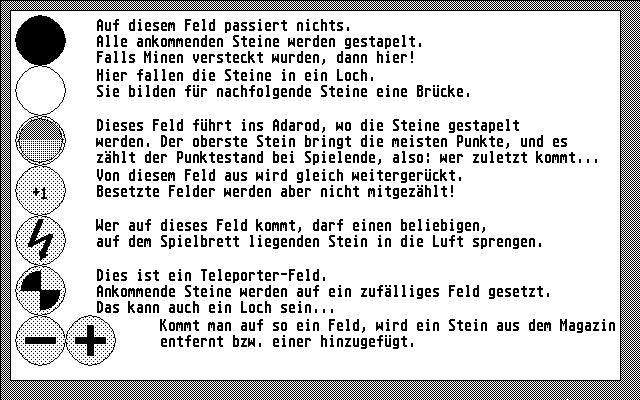
Then the board begins pulling the rug out. Numbered tiles force movement, lightning tiles let you blast an opponent’s piece away, teleporters send a piece to a random tile, and plus or minus tiles alter your current supply of pieces. These effects keep turns lively, but they can also frustrate anyone hoping for a pure strategy game. Adarod asks you to make smart choices inside a board that can abruptly rewrite your plans, not to calculate a guaranteed route from the opening move.
That mix gives the game a pleasantly mischievous party-game edge. You can plan around scoring tiles and opponent positions, but you cannot treat the board as fully obedient. If you enjoy turn-based games where a clever play and a chaotic tile can sit side by side, there is a sharp little competitive loop here. If randomness makes losses feel unfair, the teleport and disruptive tiles may wear on you.
Graphics
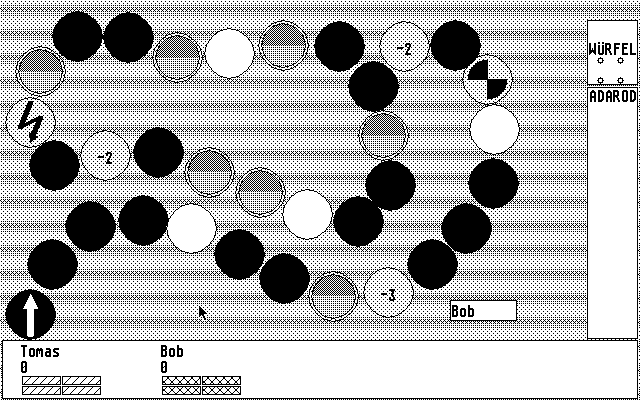
The top-down board view centers the action on eight tile types, including plain black and white spaces, numbered spaces, lightning symbols, teleporters, and plus or minus tiles. That is the right perspective for following where pieces land and how a crowded scoring tile is developing.
Visually, the changing white tiles have a useful purpose: once the first piece lands there and disappears, the tile becomes black. It is a straightforward board-game look built around keeping the state of the match in front of you.
Story
Adarod’s drama comes from the match itself rather than a narrative campaign. A game develops its own miniature arc as everyone tries to shed pieces, build a score, and interfere with one another’s best route.
The strongest moments are the reversals. A piece nearing a profitable exit can be forced onward, blasted away, or sent to a random new location, while a player who looked behind can suddenly benefit from a crowded scoring tile. Those swings give each contest a story of opportunism more than steady progress.
That makes the stakes immediate and easy to read. You are not carrying a larger plot from game to game; you are watching a compact board contest turn on placement, timing, and a well-aimed bit of disruption.
Overall Experience
Adarod has the feel of a compact tabletop contest translated into a turn-based computer game: simple objective, active board, and plenty of chances to spoil somebody else’s move. The first few turns should make sense quickly, but the score scaling on shared tiles gives you a reason to look beyond the nearest exit.
Its payoff depends on how much you enjoy volatility. The tactical decisions are real, especially around high-value tiles and opponent pieces, yet lightning, teleportation, forced movement, and changing piece counts ensure that clean plans can collapse. That is entertaining when you want a lively, argumentative board game; it is less satisfying when you want consistent control.
The board editor is a worthwhile extra for anyone willing to pay the shareware fee, since tile arrangements are central to how a match plays. Adarod is worth a chance if you like short-form competitive strategy with a dose of luck and spite. Go in ready to react, not to perfect a master plan, and its scoring battles have enough bite to justify the chaos.



Reviews
There are no reviews yet.