 Retro Replay Retro Gaming History, Reviews & Emulation

Retro Replay Review
Gameplay
The first few minutes of Marlowe put you in a detective’s office with a troubling letter from a missing friend, and that is a strong invitation to start poking at every clue. You are not dropped into a broad, undefined world; instead, the game frames the case as a sequence of places to investigate, conversations to pursue, and objects to keep in mind. The letter puzzle establishes the mood early: progress comes from stopping to think, not from reflexes.
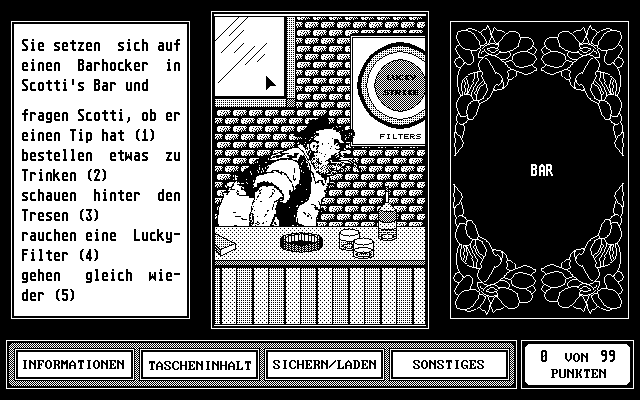
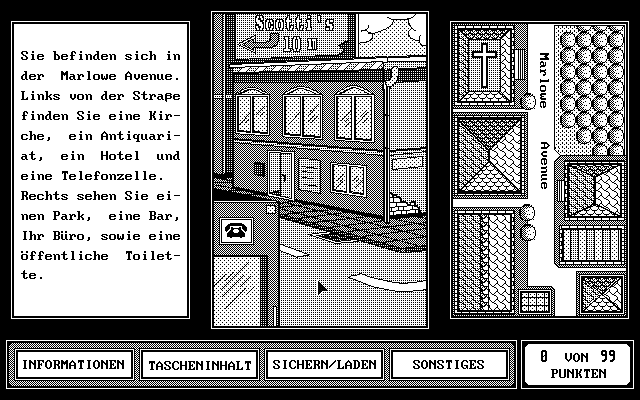
Its most distinctive strength is the three-window interface. The left panel handles descriptive text and communication with other characters, the middle panel shows where Marlowe currently is, and the right panel’s aerial floor plan lets you select the buildings or rooms you want to enter. Once you understand that division, moving through the investigation has a pleasingly organized rhythm. You can focus on what the text tells you, then use the map to act on a lead without treating navigation as a puzzle in itself.
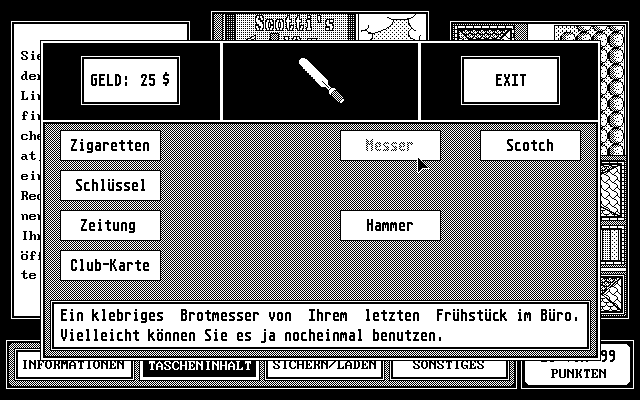
The inventory is central to the casework. Collected items are kept graphically and used when the situation calls for them, which gives the investigation its familiar adventure-game loop: notice a problem, consider what you have learned or picked up, then try a sensible connection. That can be rewarding when a clue clicks into place, although the deliberate pace will test you if you want rapid feedback or constant action.
Marlowe is for the gamer who enjoys working through a mystery one careful step at a time. Its top-down, plan-driven structure is a good fit for an evening when you would rather untangle a case than master a complicated control scheme. Go in ready to read closely and revisit your assumptions; the game’s satisfaction lies in making the next deduction yourself.
Graphics
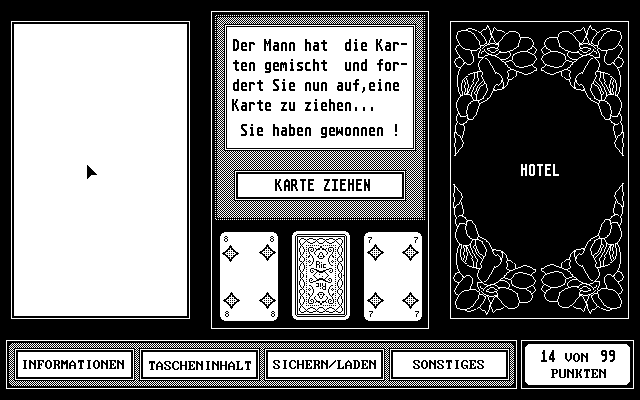
The visuals are arranged around the interface rather than full-screen scenery: a centered graphic view shows Marlowe’s current location, while an aerial floor plan occupies the right side. That overhead map is especially useful because it gives rooms and buildings a clear place in the investigation, and the graphical inventory keeps the objects you collect visible rather than buried in text.
Story
The missing-friend setup gives Marlowe a clean, immediately personal reason to investigate. Finding a strange letter in the office is a classic detective-story opening, but it is effective because it turns a familiar workspace into the first crime scene. You begin with a tangible question instead of a pile of lore.
From there, the story is built as a crime investigation. The mystery advances through the letter, the places you choose to enter, and the characters you communicate with, so the narrative and the puzzle-solving are closely tied together. You are not merely watching a detective connect the dots; you are expected to do the connecting.
That structure should suit you if you like mysteries that unfold through evidence and inquiry. The premise does not need a sprawling cast or a grand conspiracy to get its hooks in; a vanished friend and an unexplained message are enough to make each new lead matter. The case has a grounded, private-eye focus.
Overall Experience
Marlowe’s best quality is its disciplined shape. The game knows what it wants you to do: read the situation, decide where to look next, manage the useful objects you find, and keep pushing the mystery forward. The floor-plan navigation gives that routine a welcome sense of order, particularly for anyone who has bounced off adventure games that make basic movement needlessly opaque.
Its limitations are also part of the deal. This is a text-led, methodical adventure, and the same measured structure that makes the investigation feel tidy can feel slow when a solution refuses to reveal itself. You need to enjoy sitting with a clue, checking your inventory, and trying to understand why a particular location matters. There is little reason to choose it for speed or spectacle.
For a patient puzzle fan, though, the payoff is the feeling of conducting a case rather than simply being carried through one. Marlowe earns a recommendation as a focused detective adventure with a smartly arranged interface and an appropriately hands-on mystery. If a strange letter and a missing friend sound like a satisfying excuse to put your observational skills to work, this is worth investigating.


Reviews
There are no reviews yet.