 Retro Replay Retro Gaming History, Reviews & Emulation
Retro Replay Review
Gameplay
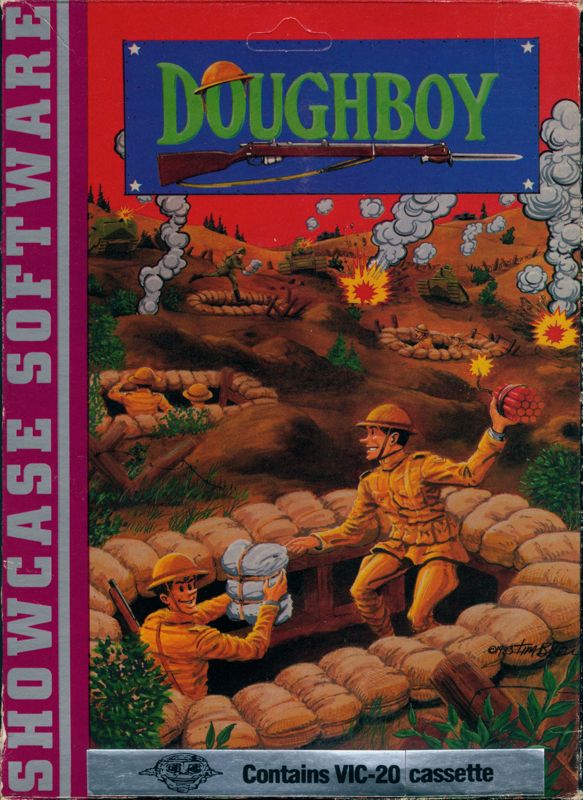
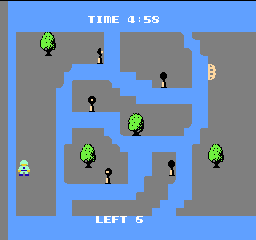
Dough Boy starts with a simple, immediately understandable problem: get a lone soldier across enemy territory and rescue the captured president. The battlefield is viewed from above, enemies patrol the route, and the clock makes every detour matter. You can shoot incoming soldiers, but this is not just a run-and-gun march. The real question is whether you have gathered the right equipment to get past the next obstruction.
That item-driven structure is where the game earns its interest. Keys, ladders, TNT, fuses, mines, and wire cutters turn each of the five maps into a small problem of access and timing. You are not merely trying to survive; you are trying to avoid reaching an obstacle empty-handed. When a route begins to make sense and your inventory contains the tool you need, the game’s forward momentum can feel satisfyingly direct.
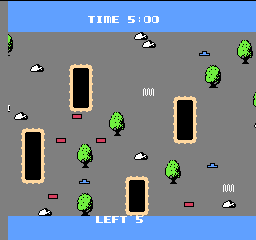
The timer also gives Dough Boy its bite. It pushes you to move decisively through trenches, obstacles, and guards rather than cautiously combing every inch of the map. That pressure can become frustrating when enemy resistance and route-finding slow you down, especially because a poor decision costs more than a few seconds. Still, the brevity of the five-map battlefield makes the tension feel purposeful rather than sprawling.
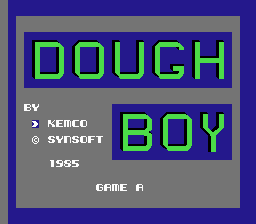
The Famicom version adds a harsher Game B, where missiles are constantly fired at you, and that sounds like a stern test for anyone who finds the basic challenge too forgiving. Its two-player mode is stranger and more interesting: one person controls the soldier while the other controls the missiles. Since those missiles can kill guards but can also hurt the soldier, cooperation can quickly turn into gleeful sabotage.
Graphics
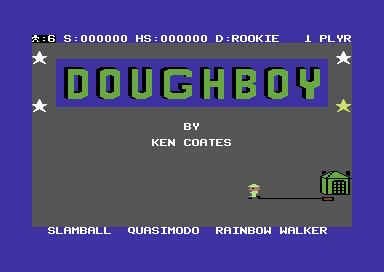
The game’s top-down battlefield view puts trenches, obstacles, scattered pickups, and enemy guards in the same compact play space. That camera suits the design: you can judge where a route is blocked and where danger is approaching without losing sight of the soldier you are trying to shepherd through the map.

Story
The story is pure arcade-era urgency: the president has been kidnapped, held behind enemy lines, and you are the soldier sent to bring him back. It is a blunt excuse for the mission, but it works because the goal is never unclear.
There is no need for a complicated military plot when the game’s maps already communicate the stakes. Trenches, guards, and a hostile route make the rescue feel like an infiltration job rather than a simple walk to an exit.
What matters most is that the premise gives every collected tool a practical purpose. You are not gathering equipment for its own sake; each piece is another possible answer to the battlefield standing between you and the prisoner.
Overall Experience
Dough Boy is most enjoyable when you treat it as a compact tactical action challenge rather than a shooter. Shooting guards helps, but careful movement, useful inventory, and fast decisions are what carry the day. The first hour’s pull comes from learning which tools solve which problems and trying to make cleaner runs through the timed maps.
Its rough edge is also its defining quality. The game asks you to work under pressure, and the same clock that creates excitement can make a stalled route feel punishing. If you want a relaxed war game or a deep campaign, this is unlikely to satisfy; it is designed around short, demanding battlefield puzzles.
Give Dough Boy a chance if you like early action games that turn a simple rescue mission into a tense sequence of small logistical decisions. The Famicom’s missile-heavy Game B and unusual two-player mode add extra reasons to revisit it, but the core draw remains the same: get the tools, find the route, and make it through before time runs out.


Reviews
There are no reviews yet.