 Retro Replay Retro Gaming History, Reviews & Emulation

Retro Replay Review
Gameplay
Mad gets to its joke quickly. You are asked for basic parts of speech—verbs, nouns, and adjectives—and the real decision is whether to answer sensibly or sabotage the coming story with the dumbest word you can think of. A single odd adjective can be funny; a whole chain of them can turn the result into the kind of nonsense that is much better when someone else is in the room to read it aloud.
There is an educational angle here, since the prompts ask you to recognize different kinds of words, but Mad does not sound like homework. It is a light writing exercise built around the payoff of the completed story. Younger players can get a little practice with language while chasing a laugh, and that is a more inviting hook than a dry drill.
The limitation is obvious once the novelty wears off: the interaction is filling in fields and reading what comes back. You are not shaping a deep narrative or mastering a complicated system. Bring your own sense of humor, vary your answers wildly, and treat each story as a quick punchline rather than something to linger over.

Graphics
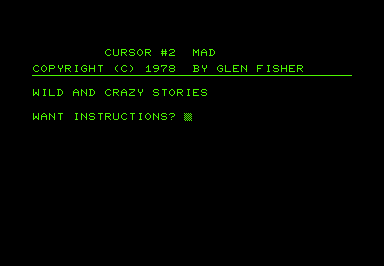
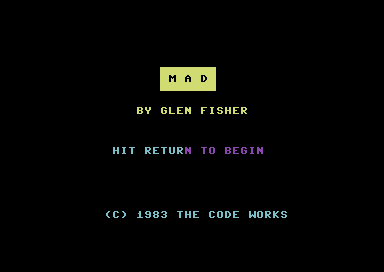
Mad is text-driven, with simple written prompts followed by the generated story. The focus stays on the words you enter and the absurd sentences the computer produces.

Story
There is no fixed tale to become invested in. Each story is assembled after you have supplied the missing words, so its character comes directly from your choices.
That makes the writing less about plot than contrast. Put a serious-sounding noun beside a childish verb, or use an overly dramatic adjective where it does not belong, and the game’s plain framework can produce a surprisingly effective joke.
The stories are intentionally nonsensical, which is both Mad’s charm and its ceiling. If you want memorable characters, a carefully written arc, or a conclusion with emotional weight, this is not trying to offer any of that. It wants a goofy result, then another goofy result.
Overall Experience
Mad is a small, cheerful computer version of a familiar word-game idea. Its first successful story explains the whole appeal: the computer handles the structure, while you supply the words that make it collapse into nonsense.
It is easier to recommend as a shared diversion than a solo game you will return to for long stretches. Passing the prompts around and trying to outdo another person’s answers gives the simple format more life. Alone, you may run out of reasons to continue after the initial laughs.
For a 1983 Commodore 64 curiosity, it has a straightforward purpose and follows through on it. Give Mad a chance if you enjoy language play, goofy improvised humor, or a gentle way to practice parts of speech. Skip it if you need challenge, depth, or stories that amount to more than the joke you wrote into them.


Reviews
There are no reviews yet.