 Retro Replay Retro Gaming History, Reviews & Emulation

Retro Replay Review
Gameplay
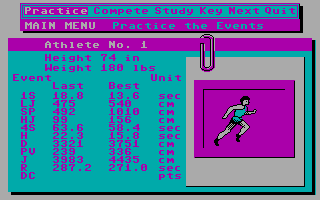
The first hour of Carl Lewis’ Go for the Gold is about learning to respect the decathlon. You can practice before committing to competition, which is more than a courtesy when ten events sit between you and the final challenge. The game does not let you live comfortably in one specialty: a strong sprint is only one part of a campaign that also asks for jumps, throws, hurdles, vaulting, and endurance.
The competition ladder gives the events purpose. Beginning at high school meets and advancing through college, national, and world competition makes improvement feel like a climb rather than a disconnected set of sports minigames. That structure is the reason to stick with it when an event does not immediately suit you; you are training an athlete for a complete test, not merely chasing a single good result.
There is useful context built around that climb, including rules for every event and contemporary USA and world records. If you enjoy understanding what each discipline demands, those references make this feel more grounded than a button-mashing novelty. Carl Lewis’ comments and tips also fit the training angle, and facing him at the end gives the long road a clean target.
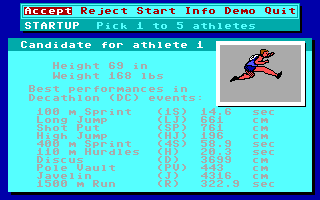
Frustration will naturally set in if you only want the instant satisfaction of one favorite track event. The 100m, long jump, shot put, high jump, 400m, 110m hurdles, discus, pole vault, javelin, and 1500m are a deliberately broad commitment. But if the idea of becoming competent across all ten is the hook, the campaign progression makes the effort worthwhile.
Graphics
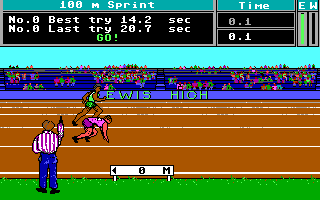
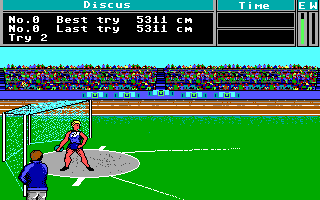
The action uses a side-view perspective, putting the athlete and each track-and-field discipline in profile. That is a sensible fit for races, hurdles, jumps, and throws, where you want a straightforward view of movement down the field or along the track.
Story
This is a sports career framework rather than a dramatic narrative, and it does not need to pretend otherwise. Your story is the rise from school competition to world meets, with the Olympic decathlon as the central ambition.
Carl Lewis is more than a name on the box: he supplies advice and commentary during the journey, then stands as the final rival. That gives the licensed premise a practical payoff. His included short biography also places the challenge in the context of the real athlete behind it.
The progression is simple, but it works because it gives every meet a place in a larger goal. You are not being asked to absorb plot twists; you are being asked to earn the right to test yourself against Lewis.
Overall Experience
Carl Lewis’ Go for the Gold has a clear, old-school sporting focus: train, learn the events, advance through tougher meets, and prove yourself across the whole decathlon. Its strongest quality is that it treats versatility as the main event. The final confrontation with Lewis feels like a reward for seeing the entire program through rather than a loose celebrity cameo.
Give it a chance if you like disciplined multi-event sports games and enjoy improving across a varied set of challenges. Practice first, read the event rules when an unfamiliar discipline trips you up, and treat the records as benchmarks instead of decoration. That mindset gets you much closer to what this game is trying to do.
It is also an interesting earlier stop for fans of the name: Carl Lewis Athletics 2000 offers a related later entry in the Carl Lewis series. Go for the Gold remains the more appealing pick when you want the full decathlon climb and a defined rival waiting at the summit.


Reviews
There are no reviews yet.