 Retro Replay Retro Gaming History, Reviews & Emulation
Retro Replay Review
Gameplay
The first few turns of Combat Checkers feel comfortably familiar: you are studying a checkerboard, lining up movement, and looking for a jump. Then the game asks you to care about who is making that jump. A capture is no longer an automatic exchange; attack and defence values decide the battle, so a seemingly obvious move can carry a very different risk depending on the piece involved.
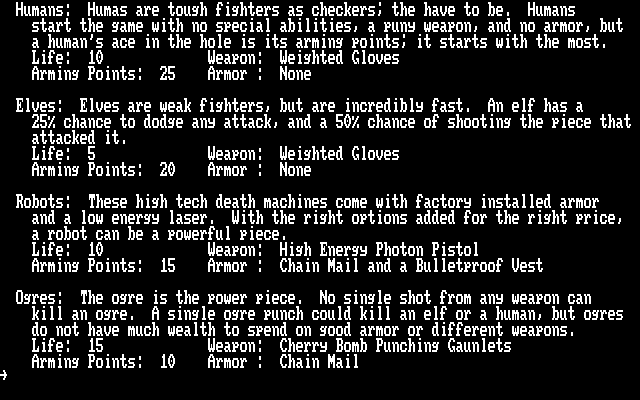
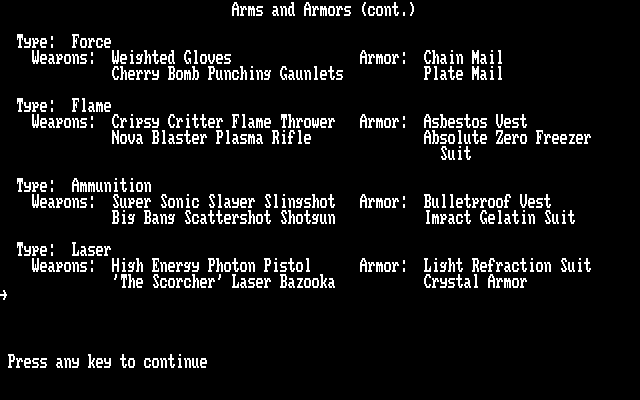
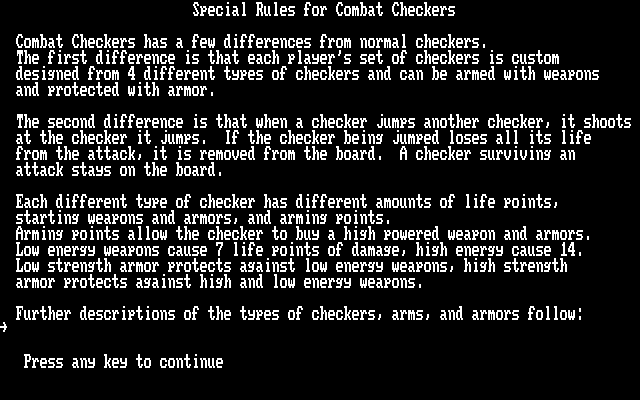
That is the game’s strongest idea. Humans, Elves, Robots, and Ogres begin with different strength and resilience values, and the ability to buy arms and armor before a match lets you build around those differences. You can spread equipment around to make every piece broadly useful, or concentrate your better gear on a few important checkers and accept that the rest are more disposable. Either way, the board stops being a set of identical counters.
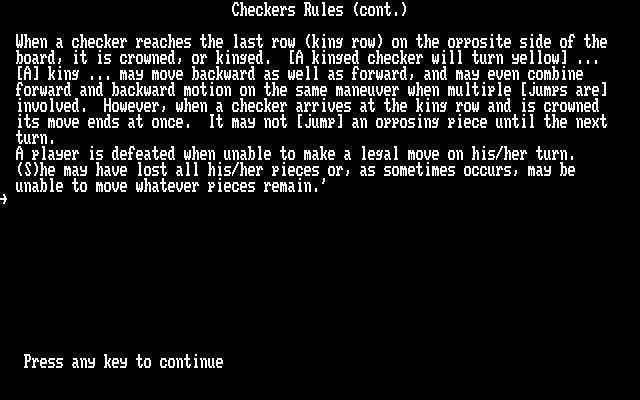
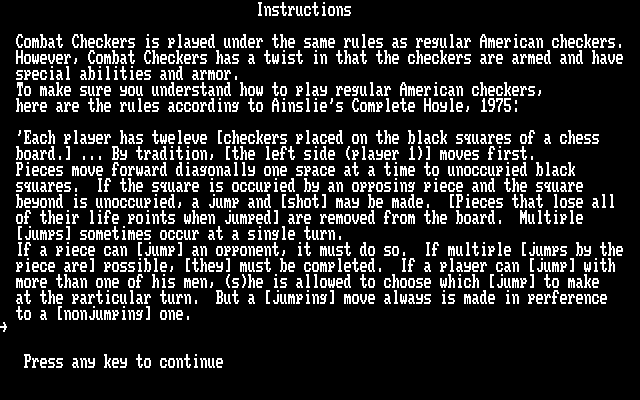
It also means Combat Checkers is less clean and pure than ordinary American checkers. You cannot treat every jump as a solved transaction, because the fighters’ values matter. For some gamers, that extra layer is exactly the point; for devoted checkers purists, it can feel like the elegance of the original has been deliberately disrupted. The payoff is that your pre-match choices remain relevant once the pieces start moving.
Single-player matches have a useful difficulty wrinkle. You can have the computer use a set you prepared, or let it bring its own selection, which raises the challenge. Saved piece and equipment setups are another good fit for the concept: rather than rebuilding from scratch every time, you can return to a lineup and see whether it really holds up.
Graphics
Combat Checkers turns its checkers into little individuals carrying arms and armor rather than plain discs. That is the right visual touch for a game built around combat statistics: when pieces clash, they look more like fighters with distinct loadouts than anonymous board markers.
Story
Combat Checkers finds its drama in the match itself, not in a scripted tale. Your side becomes a small roster of fighters defined by race, equipment, and the outcomes they earn on the board.
That makes a strong piece feel more personal than a normal checker. When you have invested in a particular loadout, sending that unit into a risky jump has more weight than moving an interchangeable token.
The races provide just enough flavor to make the contest feel like a fantasy-leaning skirmish played through checker moves. Humans, Elves, Robots, and Ogres are not there to deliver plot; they are there to change how you size up a fight.
Overall Experience
Combat Checkers is a compact strategy experiment that earns its name. It takes the board and movement patterns of American checkers, then makes each confrontation matter through character values and equipment. The result is easy to understand at a glance but more tactical than its plain premise first suggests.
The frustration is also inseparable from the hook. If you want checkers to reward only position and flawless calculation, combat values can get in the way of what you love. But if standard checkers has always felt a little too abstract, these armed pieces give you another set of decisions to chew over before and during a match.
Give it a chance if you enjoy old-school board games that remix a familiar ruleset instead of replacing it outright. Its customization, selectable races, and tougher computer setup create enough room for experimentation to make repeat matches worthwhile, especially if you enjoy tuning a squad and then testing it on a clean, turn-based board.

Reviews
There are no reviews yet.