 Retro Replay Retro Replay gaming reviews, news, emulation, geek stuff and more!
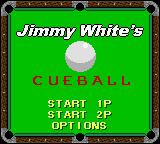

Retro Replay Review
Gameplay
The first few racks have a pleasantly direct rhythm. You choose one of four cue-sport variants, point the cue from the top-down table view, adjust spin using the small ball display, then commit to a strength on the moving power bar. There is no clutter between you and the shot, which suits a handheld pool game nicely.
What starts to click is the relationship between those three inputs. Direction gets you in the neighborhood, but spin and shot strength are where a routine attempt can become a careful setup. The power bar is also the source of the game’s most immediate tension: you have to stop its travelling line at the desired moment, so a clean idea can be spoiled by a rushed button press.
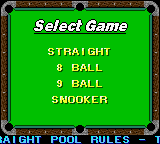
The selection of straight pool, 8-ball, 9-ball, and snooker gives the cartridge more range than a single-rule pool game. Switching formats changes what you are trying to accomplish at the table, even though the basic cue handling remains familiar. Snooker is especially welcome simply because it broadens the package beyond the most common pocket-pool rules.
You can take on Broke Ben, Nine Nigel, Suzy Cue, and Jimmy White, giving solo play a clear set of opponents rather than leaving you with only empty-table practice. Do not come in expecting a strange twist on pool; the strength here is a traditional format reduced to its essential decisions. That straightforwardness can feel dry if you want arcade chaos, but it is a good fit when you want a few deliberate frames.

Graphics
Every match is shown from a top-down view, putting the whole table in front of you and making the path from cue ball to pocket easy to judge. The miniature ball in the corner gives you a clear visual place to set spin, while the moving power bar keeps the crucial timing information close at hand.
Story
Jimmy White’s Cueball treats competition as its hook. Its cast is made up of four named opponents—Broke Ben, Nine Nigel, Suzy Cue, and Jimmy White—so the game gives each session the basic shape of sitting down across the table from somebody rather than merely running isolated drills.
That framing is deliberately light, and it matches the sport. Pool does not need much extra drama when a difficult pot, a poorly judged pace, or a useful bit of cue-ball spin can swing a turn.
The licensed Jimmy White name adds a recognizable cue-sport connection, while the rest of the opponent list keeps the focus on the matches themselves. You are here for the table-by-table contest, not for a long tale between shots.
Overall Experience
This is a no-nonsense pocket pool game with enough discipline in its shot controls to make successful pots feel earned. Its top-down view and step-by-step aiming process make it easy to understand early, while the moving power meter ensures that execution never becomes completely automatic.
The frustration point is clear: when the power line slips past the strength you wanted, there is nowhere to hide. That can make close shots feel unforgiving, especially when you had the angle and spin planned. Yet that same risk keeps a successful shot from feeling like a formality.
Give it a chance if you want a traditional, patient take on pool or snooker on Game Boy Color, especially for short sessions where you can settle into a rack or two. If the Jimmy White name has you curious about the series beyond this handheld entry, Jimmy White’s 2: Cueball on Dreamcast is a related game worth comparing. Cueball is not flashy; it is a compact rules-first game that earns its time whenever you are in the mood to line up one more careful shot.


Reviews
There are no reviews yet.