 Retro Replay Retro Gaming History, Reviews & Emulation



Retro Replay Review
Gameplay
The first few launches in Dachinko are immediately understandable: pull the lever, choose your starting speed, and hope a metal sphere finds a profitable path through the board. That simplicity is its strength. You do not need a long tutorial to understand why it feels good when a ball clips one peg, changes direction, and tumbles into a pot that gives you points or another ball. The limited supply of spheres keeps every shot from becoming mindless, too; even a casual attempt has a little tension attached to it.
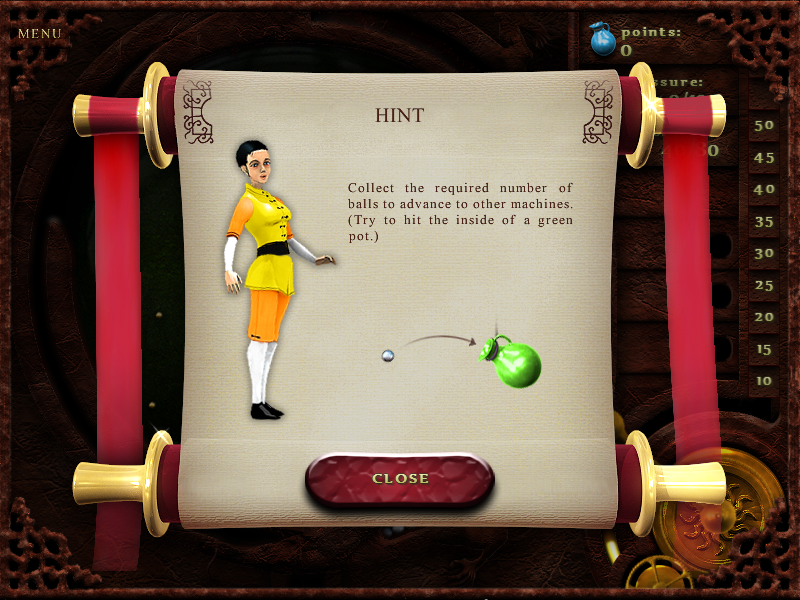
What starts to click is that this is not just a high-score chase. Each level asks you to collect a required number of extra balls, chiefly by reaching the green pot. The blue pot feeds your score, while the yellow pot helps reduce the pressure built up by missed shots. That pressure system gives bad runs teeth, since letting it climb too far starts eating into accumulated bonus points. It is a smart nudge to pay attention to more than the flashiest target, though it can also make a streak of unlucky rebounds sting.
The later additions are where the boards earn their replay value. Revolving gears, bamboo pipelines, moving platforms, and other moving objects make the path of a ball less predictable, and the random parcels and temporary power-ups can suddenly reshape a run. Reversed gravity, rubber balls, and guidance toward the nearest pot are lively interruptions rather than a replacement for careful launches. The mining-cart mini-game, which has you shifting the cart sideways to catch falling spheres, is a welcome break from simply watching a drop resolve.
Dachinko works best in short, repeatable sessions. There is enough decision-making in launch speed and target priorities to make a good result feel partly earned, but the bouncing-ball chaos remains central. If you enjoy pachinko-style games because they balance tiny bits of control against dramatic chance, that balance is the reason to stick with it. If random outcomes make you impatient, the pressure penalty may turn the same unpredictability into frustration.
Graphics
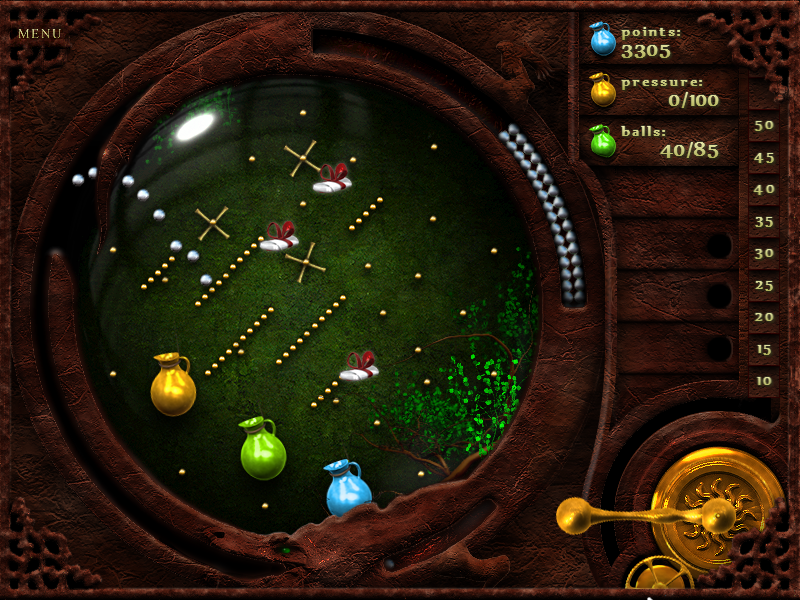
The game is built around a board full of pegs, pots, and obstacles, so the important images are the moving spheres and the routes they take through each layout. Green, blue, and yellow pots give the main targets clear visual distinction, while later boards add visible machinery such as gears, pipelines, and moving platforms to make the field less static.

Story
Dachinko is driven by the story of a run rather than a conventional narrative. A promising launch becomes a small drama on its own: will the ball find the green pot, shave down the pressure through the yellow one, or bounce uselessly through the field?
That stripped-down approach suits the arcade format. There is no need to pause a quick session for plot setup when the immediate goal—building enough extra balls to clear the level—is already clear and urgent.
The trade-off is that the game’s momentum has to come from score, survival, and the changing boards. For a gamer who wants character arcs or a larger reason to push forward, Dachinko has little to offer; for someone happy to make their own little comeback story after a rough sequence of shots, it has the right kind of stakes.
Overall Experience
Dachinko is a tidy pachinko-inspired arcade game with more structure than a pure score attack. The extra-ball objective, rising pressure, and distinct pots give each launch a purpose, while the later moving obstacles prevent the boards from feeling like identical peg fields. Its best moments come when a deliberate launch meets a fortunate chain of rebounds and suddenly solves several problems at once.
Its biggest limitation is inseparable from its genre: you can make a sensible choice at the lever and still watch the ball take an unhelpful route. Because missed shots feed the pressure system, bad luck is not merely cosmetic. That can make a close level feel exciting when you recover, or aggravating when the board refuses to cooperate.
The payoff is worth it if you like compact arcade games built around repeated attempts, incremental board knowledge, and the occasional outrageous bounce. Give Dachinko a chance when you want something lighter than a strategy game but more demanding than an idle distraction. It will not convert anyone who dislikes pachinko randomness, but it gives fans enough goals, hazards, and temporary twists to keep pulling the lever one more time.


Reviews
There are no reviews yet.