 Retro Replay Retro Gaming History, Reviews & Emulation

Retro Replay Review
Gameplay
The first stretch has a clean, purposeful pull. You are not wandering around for a vague treasure or trying to decipher an enormous mystery; you need to deliver medicine after a biomonster attack. That makes every new location, conversation, and scavenged item feel tied to a concrete problem, which is exactly what a short-form text adventure needs.
Most of your time goes into the classic loop of looking around, speaking with characters for clues, and collecting items that can solve the next obstacle. If you enjoy working through a chain of practical little problems, the structure has a pleasing directness. Progress depends on paying attention to what people tell you and considering what each item might be good for, rather than simply pushing ahead through combat.
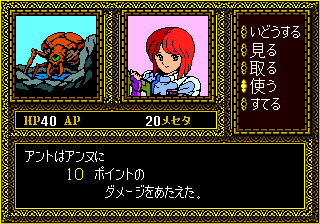
Combat is simple but has some bite because damage comes from a weapon’s attack power multiplied by a random dice roll; enemies play by the same rule. An item that seems like ordinary inventory can become a weapon, which is a nice reason to think twice before dismissing it. Still, the randomness can frustrate you when a fight swings against you. These encounters are about draining enemy HP, not developing a deep battle strategy, so treat them as tense interruptions to the investigation rather than the game’s strongest attraction.
Graphics
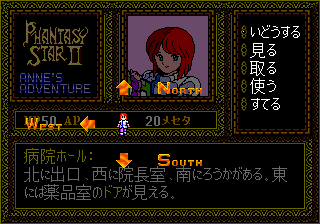
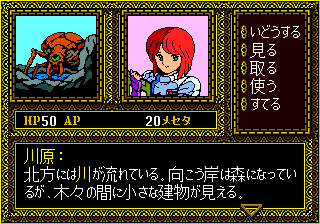
This is a first-person text adventure with anime/manga and sci-fi framing, so the written locations, clues, and encounters carry much of the imagination. Its strongest images come from the premise itself: a school under threat, medicine that must get through, and biomonsters standing in the way.
Story
The story earns its place as a Phantasy Star II companion by narrowing its focus. Instead of trying to compete with a sprawling role-playing quest, it follows a doctor dealing with the immediate fallout of an attack. That smaller scale makes the stakes easy to grasp: people need help, and you have a job to do.
There is something appealing about the medical errand at the center of the adventure. It gives the sci-fi setting a grounded problem rather than treating danger as an excuse for another dungeon crawl. The quest’s human purpose makes conversations and item hunts feel more meaningful than they would in a purely abstract puzzle game.
Do not come in expecting a complete replacement for the larger story that follows in Phantasy Star II. This is a character-focused prelude, and its value lies in spending time with one corner of that world and seeing a crisis handled from a different perspective. That is a worthwhile premise for fans who enjoy supplementary fiction, especially when it stays focused instead of overreaching.
Overall Experience
Anne no Bōken is easiest to enjoy when you meet it on its own modest terms: a compact sci-fi text adventure built around clue gathering, inventory puzzles, and a little dicey combat. The central mission gives it more momentum than many old-school adventure setups, and the item-based progression is satisfying when a previously overlooked object becomes the answer.
The rough edge is the combat randomness. Since attack strength can rise or fall on a dice roll, winning is not always a matter of making a clever tactical choice. If you want every setback to be fully under your control, that can wear thin. If you can accept brief, luck-driven fights as part of an older adventure-game rhythm, they add danger without taking over the journey.
This is worth a look for Phantasy Star fans curious about the stories around Phantasy Star II, and for anyone who likes concise adventures that ask them to investigate rather than grind. The payoff is not a huge epic; it is the satisfaction of following a clear rescue mission through a series of clues and problems, with a bit of uncertainty whenever biomonsters force the issue.


Reviews
There are no reviews yet.