 Retro Replay Retro Gaming History, Reviews & Emulation

Retro Replay Review
Gameplay
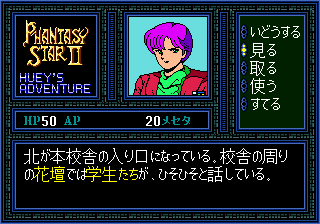
The first hour has the right kind of old adventure-game pull. You arrive at Motavian University with a clear assignment—find out what this strange creature is—and immediately start doing the satisfying basics: examine locations, look for people with something useful to say, and collect objects that may solve the next obstacle. There is no need to untangle an enormous premise before you can begin; you are investigating a rumor, following clues, and seeing where the campus sends you.
Conversation and searching are the backbone of progress. That makes this a game for a patient, methodical mood. If you enjoy stopping at every location to see what can be found and treating each character as a possible source of the next lead, the structure has a steady detective-like rhythm. If you want fast momentum or direct objectives at every turn, its clue hunting may feel slow, especially when the important next step depends on noticing an item or person.
Combat gives the adventure a sharper edge than a pure puzzle game. Some of the items you pick up can become weapons, and each attack is determined by a weapon’s power multiplied by a random dice roll. Both you and an enemy live or die by that uncertainty until one side’s HP is gone. It is simple, but it means a fight can swing harder than your preparation suggests. That unpredictability adds tension; it can also sting when a weak roll undermines a sensible choice.

Graphics
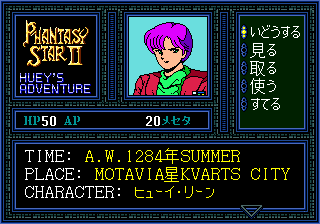
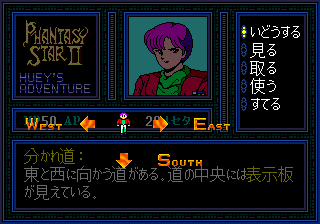
As a first-person text adventure, the game centers your attention on the places you investigate and the information you uncover there. The Motavian University setting gives the mystery a more contained, everyday starting point than the larger-scale science-fiction conflict associated with Phantasy Star II.
Story
Huey’s adventure works because it narrows its focus. Hugh Thompson is not introduced as a conquering hero; he is a biologist assigned to check out a disturbing report on a university campus. That is a strong setup for a text adventure, since every conversation and newly discovered object can plausibly feel like part of an investigation rather than a detached puzzle.
The creature rumor supplies a clean thread through the exploration. You know why you are asking questions, why you are searching rooms, and why a useful item matters. The story’s greatest strength is that it does not need a sprawling goal to create curiosity: a strange thing is loose, people around the campus may know more than they first reveal, and you are there to put the pieces together.
It also has extra value if you care about the wider Phantasy Star II cast and setting. This is one of the character-focused adventures set before that game’s continuing story, so the smaller mystery functions as a chance to spend time with Hugh before the larger narrative moves on. Newcomers can still follow the basic case, but series fans have the clearest reason to seek it out.
Overall Experience
Phantasy Star II Text Adventure: Huey no Bōken is a focused piece of retro adventure design: investigate, converse, search, use what you find, and survive the occasional fight. Its strongest moments come when a clue points you toward another corner of the university and a mundane-looking object suddenly becomes the answer to a problem. The campus mystery gives all that rummaging a useful sense of purpose.
The main compromise is the combat randomness. Weapon strength matters, but dice rolls can make victory feel less fully under your control than the exploration does. Go in ready to accept that volatility rather than expecting a carefully tactical battle system, and it becomes a small source of risk instead of a complete derailment.
Give it a chance if you like compact text adventures, patient investigation, and Phantasy Star side stories that linger on an individual character rather than a galaxy-spanning crisis. It will not convert anyone who dislikes searching for clues or chance-based combat, but its straightforward mystery and purposeful item hunting make it a worthwhile detour for the right retro mood.



Reviews
There are no reviews yet.