 Retro Replay Retro Gaming History, Reviews & Emulation


Retro Replay Review
Gameplay
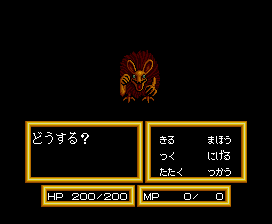
The first hour gives you a clean, immediate reason to move: Sophia is missing, monsters took her into a cave, and Alan is the only one heading after her. Mashō Denki: La Valeur does not waste that setup on a wandering party or a sprawling world map. You travel alone through connected locations, follow a linear story path, and settle into the familiar rhythm of exploration, random encounters, money, experience, and turn-based fights.
What keeps the combat from being entirely routine is the three-way weapon system. Slashing, piercing, and bludgeoning attacks are not interchangeable, because enemies have their own strengths and weaknesses against those damage classes. That gives you a practical reason to think about your equipment instead of simply carrying the weapon with the largest number attached. When the matchups start clicking, even ordinary battles have a little more texture than the genre’s most basic attack-and-heal loops.
Magic asks for more legwork. You obtain keys from wizards in towns, use them to seek out treasure chests in the surrounding areas, recover different magic rings, then return them to a wizard to learn spells. It is a deliberately circuitous progression path, but it gives exploration a concrete reward and makes new magic feel earned rather than handed out at a level-up.
The hard truth is that the game is built around grinding. You will commonly need to hit a required level before a boss becomes manageable, and regular enemies eventually stop giving experience in an area once you reach that threshold. That latter rule does prevent endless overleveling in one place, yet it also makes the intended road very clear: fight until the game says you are ready, then move on. If you enjoy old RPGs as a steady routine of mapping, battling, and preparing for the next wall, it can be satisfying. If random encounters already test your patience, this is likely where the journey loses you.

Graphics
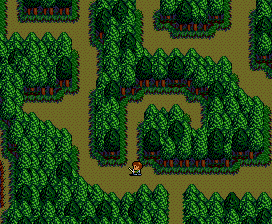
The game uses top-down locations for exploration and turn-based battles, fitting its classic Japanese RPG structure. Its fantasy setting is carried by Alan’s solo trek through towns, surrounding areas, caves, and monster-filled encounters rather than by a party-focused adventure.
Story
La Valeur opens on a straightforward rescue: Alan arrives in Flodi and finds the elder’s daughter, Sophia, has been kidnapped and taken to a nearby cave. It is an efficient hook because it gives you a destination immediately, not a pile of lore to sort through before the adventure can begin.
From there, the rescue is only the first stop on a larger run of dangers. The story follows a linear route, which suits a game so focused on measured progression and area-by-area advancement. You are not being asked to create your own path; you are being led through Alan’s ordeal, with each new obstacle functioning as the next test of whether your equipment, magic, and level are up to scratch.
The solo structure gives the adventure a particular flavor. Without party members, there is no group chemistry to carry the quieter stretches, so the focus stays firmly on Alan’s forward motion and the practical business of getting stronger. That can feel spare, but it also makes the game admirably direct: this is one swordsman’s journey, not an ensemble drama.
Overall Experience
Mashō Denki: La Valeur is an old-fashioned RPG with a few smart ideas tucked inside a very demanding progression structure. Weapon categories give combat a useful tactical nudge, and the ring-based magic hunt makes exploring around towns worthwhile. Neither idea completely transforms the formula, but both make the game more engaging than a pure sequence of random battles.
The deciding factor is your tolerance for its leveling demands. Bosses are intended to stop you until you have done enough fighting, and the experience cutoff means you cannot simply camp forever in a comfortable area. That creates a firm, occasionally frustrating cadence: learn an area, reach its cap, face the boss, and earn the right to continue.
Give it a chance if you enjoy solo, linear Japanese RPGs that ask you to work for every breakthrough and do not mind random encounters being central to the experience. The payoff is the satisfaction of slowly mastering a rigid adventure on its own terms. For anyone looking for a breezier quest or a combat system that stays flexible when you hit resistance, Alan’s road to Sophia may feel more like a grind than a grand rescue.


Reviews
There are no reviews yet.