 Retro Replay Retro Gaming History, Reviews & Emulation


Retro Replay Review
Gameplay
The first hour’s pull comes from being dropped into a mystery that sounds unbelievable even to the doctors treating Hiroyuki Kitahara. You know he saw something horrific, but proving it and understanding the connection to the town’s onryō becomes the reason to keep moving from place to place. That is a clean setup for a horror adventure: you are not saving the world yet; you are trying to make sense of something that has already shattered an ordinary evening.
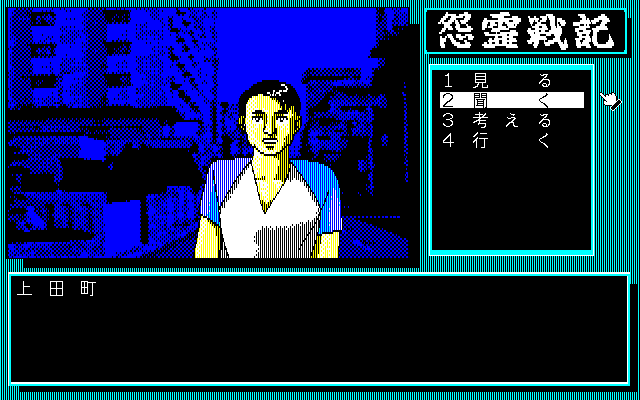
Onryō Senki is unusually direct about what kind of adventure it is. There are no items to collect, combine, or use, and no conventional puzzles waiting for the one clever solution. Instead, you work through command menus—Look, Listen, Think, and Go—often drilling down into sub-menus to inspect particular subjects. It makes progress feel more like conducting an investigation than solving a series of mechanical obstacles.
That approach will either be refreshing or frustrating. Being able to visit many parts of town in a flexible order gives you room to follow your own curiosity, and the computer at Kitahara’s home adds a useful research angle through dossiers and stored information. But without inventory experimentation or puzzle breakthroughs, much of the momentum rests on whether you enjoy exhausting lines of inquiry. Give it a chance if you like patient detective work; skip it if you need every scene to challenge your hands as well as your attention.
Graphics
The game uses a first-person viewpoint to place you in its Japanese town and its horror encounters. Its anime/manga classification fits the character-focused supernatural premise, with the contrast between everyday locations and the sudden monster encounter doing much of the visual heavy lifting.

Story
The story’s best decision is starting small. Hiroyuki Kitahara is not introduced as a hardened investigator; he is a man whose quiet night out ends with a terrifying sight and a hospital stay. His inability to convince the doctors gives the mystery a personal edge before the larger ghost story takes over.
Teaming him with a young female journalist is a sensible way to widen the investigation beyond his own testimony. Their search leads through the city toward onryō: spirits of people wronged in life who return seeking revenge. That folklore-rooted premise gives the game more texture than a generic monster hunt, because every frightening encounter points back toward human grievances.
The story also benefits from the town structure. Since you can pursue locations in varying order, the case is built around gathering clues rather than being marched through a fixed sequence of set pieces. For more background on the game itself, the Onryō Senki history and release information is useful context, but the central draw remains the gradual uncovering of why the dead refuse to stay quiet.
Overall Experience
Onryō Senki is a niche horror adventure with a clear strength: it understands that a mystery can be compelling without turning every obstacle into an item puzzle. The menu interface and research-oriented structure make you feel like you are collecting testimony, checking leads, and trying to connect a town’s buried history to its present danger.
Its limitation is just as clear. The same stripped-down design that keeps the investigation focused can make the game feel passive if you prefer adventures driven by object use and elaborate puzzle solving. You are spending more time deciding what to ask, inspect, and reconsider than manipulating a world.
Still, that restraint suits the premise. The payoff is likely strongest for anyone drawn to late-1980s Japanese horror, folklore-based ghost stories, and old-school adventures that let atmosphere and inquiry carry the experience. It is not a broad recommendation, but it is an easy one to make for a patient gamer who wants a supernatural case rather than a puzzle gauntlet.


Reviews
There are no reviews yet.