 Retro Replay Retro Gaming History, Reviews & Emulation
Retro Replay Review
Gameplay
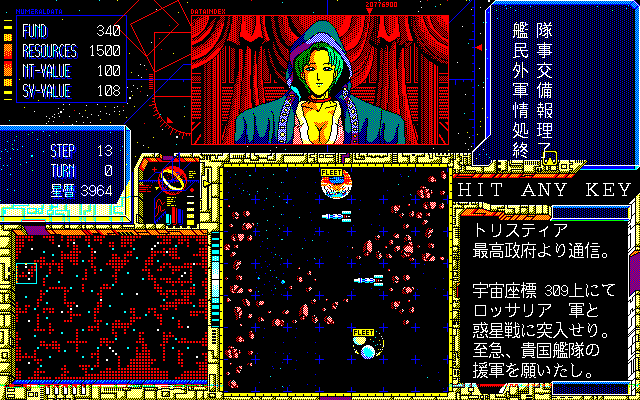
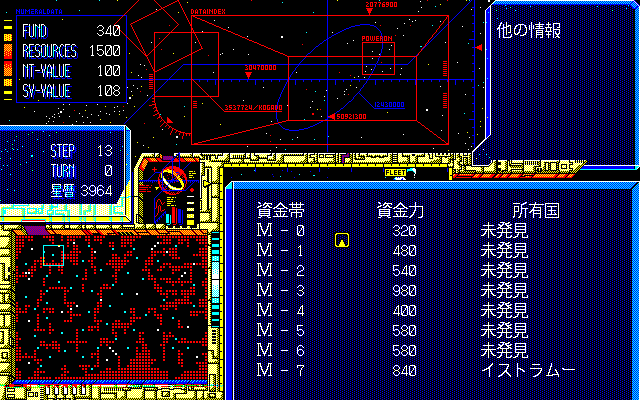
The first thing Schwarzschild II makes clear is that it wants you thinking several turns ahead. Money and resources are not background numbers: they determine whether you can assemble the fleet needed to protect the new kingdom in the Somari system. That gives even routine decisions a little weight. Building strength feels less like collecting toys and more like preparing for a war you may not be ready to fight.
Its biggest commitment is also its most likely source of friction. When battle begins, ship movement and attacks play out automatically. You can alter general commands during your turn, but you cannot directly navigate individual ships. That can be aggravating if you see an obvious maneuver and want to execute it yourself. Schwarzschild II is not interested in rewarding rapid tactical correction; it rewards the plan you made before the shooting started.
Once that boundary clicks, the game’s strategic focus becomes its best feature. Fleet construction, financial management, resource use, and diplomacy all feed into the same larger contest. A bad military position cannot simply be rescued through clever unit handling, which makes prior decisions matter. Give it a chance if you enjoy turn-based strategy that asks for patience and accepts that command sometimes means issuing orders rather than personally moving every piece.
Graphics
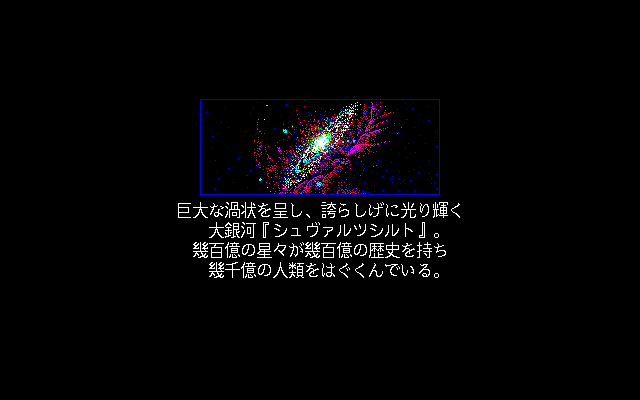
The game retains a visual style close to its predecessor, Kyōran no Ginga: Schwarzschild, and its anime/manga framing fits the science-fiction setting. This is a menu-driven MSX strategy game whose imagery serves a long campaign of administration and war rather than competing for attention with the decisions.
Story
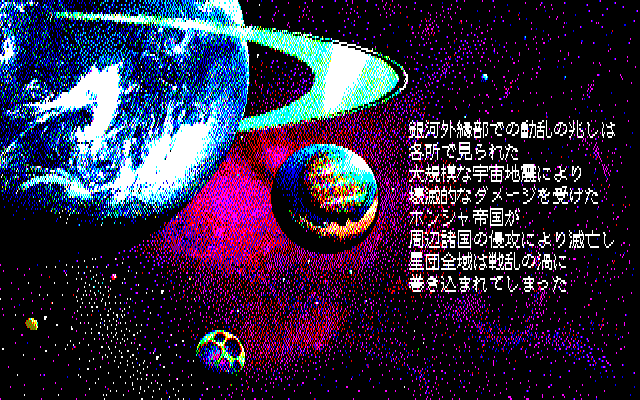
The war has a suitably unstable starting point. It is 3964, four years after the prior game, and the Jiro star cluster has been thrown into chaos by natural disasters and the military strategy of the Honsha Empire. That wider disorder gives the conflict more texture than a simple expansion campaign: this is a region already strained before the player’s kingdom comes under pressure.
The immediate stake is the survival of a newly established kingdom in the Somari star system. Its hope for peace is cut short by combined action from Lossaria and Tristia, leaving defense and eventual victory as the central goal. It is a clean strategic setup, and it suits a game built around building capacity before committing to war.
Don’t come here expecting the story to pull focus away from the campaign layer. Its role is to give your economic and military choices a reason to matter. The premise works because every fleet decision points back to a clear problem: a young state is surrounded by hostility and has to endure it.
Overall Experience
Schwarzschild II is deliberately more concerned with strategy than tactics, and it does not soften that preference. The lack of direct ship control will either make the battles feel like the honest outcome of your leadership or leave you wishing the game would let you intervene. There is little middle ground.
For the right strategy fan, that severity is the payoff. You are asked to build the conditions for success through finances, resources, fleet strength, diplomacy, and broad commands, then accept the result. It creates a different kind of satisfaction from a tactics game: not the thrill of a perfect move, but the relief of realizing your earlier preparation was enough.
As a sequel, it keeps the gameplay, interface, and visual approach close to its predecessor, so continuity is part of the package rather than a reinvention. That makes it an easy recommendation for anyone who liked the first Schwarzschild’s high-level approach. Newcomers should go in ready to learn a demanding, hands-off form of turn-based space strategy; if that sounds appealing, the game’s uncompromising structure is worth the effort.


Reviews
There are no reviews yet.