 Retro Replay Retro Gaming History, Reviews & Emulation

Retro Replay Review
Gameplay
Meikyū Jiin Dababa starts with a wonderfully direct loop. You guide a monk across a tile-filled labyrinth, hopping onto sealed spaces to reveal them, then open the exit once every seal is cleared. There is no long warm-up required: you see the objective, start plotting a route, and quickly learn that a straightforward-looking floor can become awkward when enemies are jumping across the same spaces.
The best part is the tension between completion and survival. Clearing every seal encourages you to cover the board carefully, but enemies make leisurely route planning risky. That turns each stage into a compact action-puzzle, where it is not enough to know which tiles remain; you also need to judge whether reaching them now leaves you exposed. When that balance clicks, even a simple jump from one tile to the next feels like a decision rather than busywork.
Trick doors are the sharper edge of the design. Being sent back to an earlier stage is an effective threat because it makes progress feel fragile, but it can also be the point where frustration takes over. This is not a forgiving game built around constant forward momentum. You need to accept setbacks, memorize trouble spots, and stay alert even when a stage seems nearly solved. If that kind of stern arcade logic sounds appealing, Dababa has more bite than its basic objective suggests.

Graphics
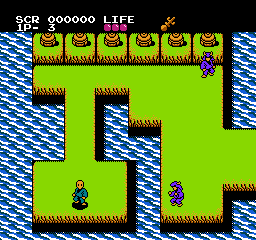
The game uses a 2D scrolling view centered on tile labyrinths, with the monk, jumping enemies, sealed tiles, doors, and gateway serving as the important on-screen landmarks. Its clearest visual strength is function: you can focus on the spaces you need to uncover and the hazards sharing the board with you.
Story
The story is pure rescue-game fuel. A monk living peacefully with his lover has that life shattered when a demon abducts her and locks her in the temple of Dababa. It gives the journey an immediate personal stake without slowing the game down.
India and the temple provide the setting, while the demon and the trapped partner establish a clear villain and finish line. The plot does not need elaborate detours because the labyrinth already supplies the real obstacle: getting through it before losing your final monk.
That simplicity fits the game’s brisk stage-based structure. You are not asked to untangle a complicated narrative; you are pushed onward by the promise that every cleared gateway brings the rescue closer.
Overall Experience
Meikyū Jiin Dababa is a compact, demanding blend of hopping action and board-clearing puzzle design. Its central idea remains easy to grasp, yet the combination of enemy movement, required seal coverage, and punishing doors gives it a mean streak that can keep you engaged well beyond the first few stages.
The payoff comes from learning to treat each labyrinth as a route-planning problem rather than blindly chasing the nearest remaining seal. Success feels earned because the game makes a careless jump matter. Conversely, if repeated reversals make you want to quit rather than rethink your approach, the trick doors may sour the whole trip.
Give it a chance if you enjoy concise NES challenges where clear rules hide demanding execution. It is not gentle, and it does not need to be: Dababa’s strength is how much pressure it gets from a monk, a grid of tiles, and one very inconvenient temple.


Reviews
There are no reviews yet.