 Retro Replay Retro Replay gaming reviews, news, emulation, geek stuff and more!

Retro Replay Review
Gameplay
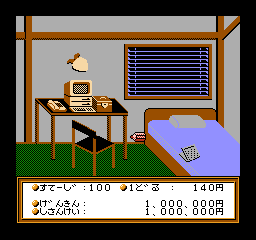
The Money Game starts with a clean, understandable hook: you have ¥1 million, 100 days, and a chance to turn market decisions into the kind of money that buys fancy cars and houses. That deadline gives even small choices some bite. You are not merely poking around an office; every newspaper check and computer visit is tied to the question of whether you are wasting another day or moving closer to a profit.
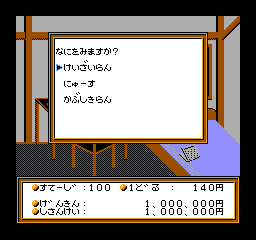
Your routine revolves around the room’s few useful tools. Read the newspaper’s financial column for market information, use the phone, then sit at the computer to check your finances and buy or sell stocks. It is a compact loop, and it asks you to pay attention rather than burying you in a huge boardroom simulation. When it clicks, the appeal is in making a call with limited information and watching your bankroll become the proof of whether it was smart.
That simplicity also draws a hard line around the experience. The office interactions and stock trading are the whole game, so repetition can become frustrating if your investments do not build momentum. There is little room to hide from a bad run when the calendar is always advancing. Still, the 100-day structure keeps it from becoming a directionless money sandbox: set a purchase goal, make your trades count, and accept that the pressure is the point.
Graphics
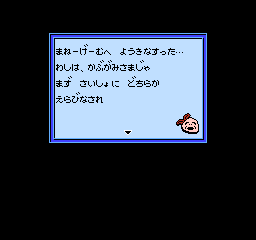
The game is viewed from inside an office room, where the newspaper, phone, and computer serve as the key objects you interact with. Its first-person setup suits the desktop-scale premise: you are meant to feel parked at a workstation making financial decisions, not commanding a sprawling city or watching a busy trading floor.
Story
There is no grand tale pulling you through The Money Game. Your story is the modest but relatable one you create yourself: start with ¥1 million, try to make it grow, and use the proceeds on status-symbol purchases such as cars and houses.
That framing is enough to give the numbers a purpose. Buying stock is not treated as an abstract high-score exercise; it is the route toward things you can afford only if you succeed. A player who enjoys setting a personal target will get more out of it than someone waiting for characters or plot turns to arrive.
The 100-day limit is the closest thing to dramatic structure. It turns the run into a short career with a finish line, so the tension comes from whether your financial decisions will amount to anything before time expires. The game does not need much more narrative weight than that, but it is decidedly thin if you come to simulations for storytelling.
Overall Experience
The Money Game is an unusually focused NES simulation: one room, one bankroll, one market, and one ticking deadline. Its strongest quality is that it does not overcomplicate its central fantasy. You can sit down, assess the available information, make a trade, and immediately understand what you are trying to achieve.
The trade-off is a very limited range of activity. The same office routine must carry the full 100 days, and your enjoyment depends heavily on whether market speculation itself feels exciting to you. If you like the quiet tension of risking virtual cash and chasing a concrete spending goal, that restriction can feel disciplined. If not, it can feel like paperwork with a countdown clock.
Give it a chance if you want a compact, goal-driven stock-market game and can enjoy making your own stakes out of its purchase targets. For everyone else, its novelty may wear off before the deadline does. It is more interesting as a focused experiment in financial pressure than as a broadly entertaining simulation, but the core loop has enough bite to reward a patient run.


Reviews
There are no reviews yet.