 Retro Replay Retro Gaming History, Reviews & Emulation
Retro Replay Review
Gameplay
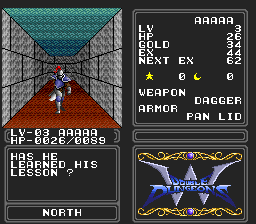
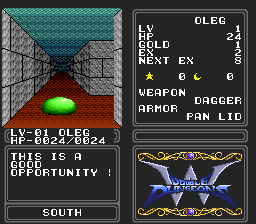
The first few minutes of Double Dungeons are oddly immediate. You choose from its 20 dungeons, step into a pseudo-3D corridor maze, and start making the kind of cautious turns that old first-person crawlers demand. Directions stay on screen, which helps you maintain your bearings, but there is no auto-map to rescue you once every similar-looking corridor starts blurring together. If you enjoy drawing maps or building one mentally, that friction is the game’s main hook.
Combat is where the experience narrows fast. Monsters appear at fixed points, can return after you have beaten them, and block your progress until you attack. Although battles are turn-based in structure, the pace is quick and enemies still hurt you while you hesitate. Your contribution is simply pressing the attack button. There are no spells, defensive decisions, party roles, or alternate attacks to turn an encounter around; after a while, each fight feels less like a battle and more like a toll booth between stretches of navigation.
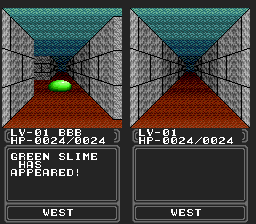
Equipment and healing items add a little survival pressure, particularly because healing happens outside battle and enemies may drop useful items. Yet automatic leveling removes another chance for you to shape a character. The higher-numbered dungeons raise the danger through tougher enemies, but the fundamentals never develop into something richer. Two-player split screen is the standout variation: each person starts at a different point in the dungeon, making it a fun, scrappy shared exercise in getting lost rather than a true cooperative combat system.
Give it a chance if the act of navigating an unmapped maze is enough to carry you, and start with a lower-numbered dungeon to learn its rhythm. Anyone looking for tactical RPG combat or satisfying character building will likely hit the wall early.
Graphics
The game uses a pseudo-3D first-person view of dungeon corridors, with the same textures reused across its 20 layouts. That repetition makes the mazes feel more confusing than atmospheric, since the walls offer few visual landmarks to anchor a route. On the upside, the persistent directional display is useful when you are trying to reconstruct where you have been.
In two-player mode, the screen splits so both explorers can navigate from their separate starting positions. It is a neat fit for the premise, even if the shared dungeon textures do little to make either half memorable.
Story
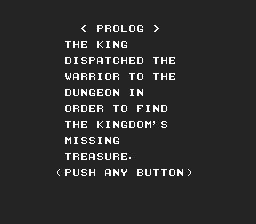
There is barely a story here, and Double Dungeons does not pretend otherwise. Each dungeon receives a brief mission setup—such as a king sending a warrior after a treasure—then gets out of the way. You are given an objective, a maze, and monsters between you and the exit.
That minimal approach can work when the journey itself produces surprises, but these introductions do not build into a larger adventure or give the individual dungeons much personality. They are functional prompts rather than reasons to care about what lies ahead.
If you want lore, characters, or a fantasy world that accumulates meaning over a long crawl, look elsewhere. Here, the story is little more than a label on the next obstacle course.
Overall Experience
Double Dungeons has the bones of a compellingly austere dungeon crawler: unexplored corridors, limited healing, escalating danger, and the nagging fear that you missed a turn somewhere behind you. For a short session, its directness can be refreshing. You always know the immediate task, and the lack of complicated systems means you can settle into the maze almost instantly.
But austerity turns into monotony because the game gives you too few ways to respond to its challenges. Navigation carries nearly all the weight, while combat becomes repetitive button pressing and automatic leveling keeps growth at arm’s length. Reused dungeon textures further sap the 20-dungeon structure of the sense that each new destination is a fresh expedition.
The split-screen option gives it a better case as a retro curiosity, especially if you have a friend willing to compare notes while both of you wander from different entrances. Solo, it is much harder to overlook how thin the loop is. Double Dungeons is worth sampling for dedicated fans of early maze crawlers, but most gamers will find its restrictive combat and repetitive spaces harder to forgive than its simple premise is charming.


Reviews
There are no reviews yet.