 Retro Replay Retro Replay gaming reviews, news, emulation, geek stuff and more!
Retro Replay Review
Gameplay
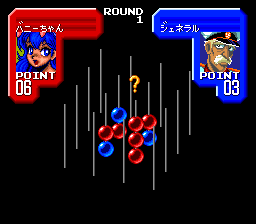
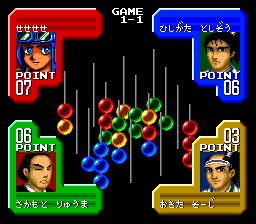
Your first few turns in Color Wars are easy to understand and hard to take back. You drop a colored ball onto a pole, then any adjacent balls—horizontal, vertical, or diagonal—can be captured and changed to your color. Since points come from the number of balls you control, the immediate temptation is to grab every conversion you can see. That instinct is useful, but it is not enough.
What starts to click is the importance of leaving the board in an awkward shape for the next player. All poles have the same height, the round ends only once there is no room left, and every placement changes the neighborhood around it. You are not merely counting the balls you flip this turn; you are trying to avoid creating a generous cluster that another color can seize on the next. The rotatable 3D board is especially helpful here, because it lets you inspect the pole layout rather than guessing how the occupied spaces connect.
The four-player format is where the game’s nasty little tactical side has the most room to breathe. With three rivals, the leading color can become an obvious target, and a smart move may be one that lets two opponents hurt each other rather than one that gives you a modest gain. That same chaos can frustrate anyone who wants a clean head-to-head contest: a turn order swing can matter, and waiting through other players’ deliberations is part of the deal. Fortunately, the game also supports two-player matches, either against another person or the computer, for a more direct duel.
Graphics
The board is built around colored balls stacked on equal-height poles, viewed on a rotatable 3D screen. It is a functional look rather than a lavish one, but the ability to turn the board matters: you can check crowded pole tops and trace diagonal capture opportunities without losing the spatial layout.
Story
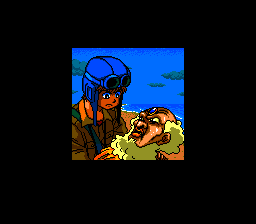
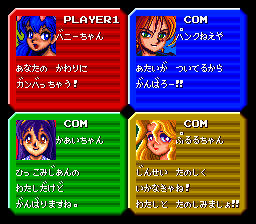
Story mode opens with a powerful demon that can only be defeated through a trip to the Color World. A young pilot makes that journey, then advances by beating opponents in Color Wars matches. It is a straightforward excuse to turn a sequence of boards into a quest, not a story that competes with the strategy for your attention.
That restraint works in the game’s favor. You know why you are moving from stage to stage, but the matches remain the focus, which is exactly where they should be. The premise has a pleasantly offbeat early-1990s flavor: demon menace, a pilot, and a world where a colored-ball contest is the route to victory.
Do not come in expecting the narrative to carry you through a weak puzzle game. Its job is to give solo play some forward motion while you learn to read capture patterns against three AI opponents. If the board game itself grips you, the campaign context is a welcome wrapper.
Overall Experience
Color Wars is a strong fit if you enjoy abstract strategy games that reveal their depth through a single clear rule. Placing a ball and converting nearby colors is instantly legible; anticipating the retaliatory capture a turn later is the satisfying part. The game earns its strategy label because board position, timing, and rival priorities keep that simple action from staying simple.
Its best sessions will likely be competitive ones with a small group. Four human opponents can turn a quiet placement into a table-wide argument about who just handed whom the lead, while the free mode makes those matches easy to set up. The solo story and computer options are valuable practice, but the social tension is where the format feels most alive.
Give it a chance if you want a turn-based contest with a board-game heart and enough spatial trickery to punish autopilot play. Skip it only if you need elaborate story development or rapid-fire action. For everyone else, Color Wars turns a handful of colored balls into a surprisingly sharp fight for every last point.


Reviews
There are no reviews yet.