 Retro Replay Retro Gaming History, Reviews & Emulation
Retro Replay Review
Gameplay
The first few rounds work because Family Feud has always had a clean competitive rhythm: buzz in, hope your answer ranks highly, then decide whether your side can clear the board before three strikes. You do not need to learn a complicated system before the fun starts. A good answer feels clever, a bad answer gets a laugh, and the chance to steal points keeps the team that is sitting out from completely checking out.
The important distinction is that this is less about knowing facts than anticipating the answers given by a survey group. That can be a great fit for a living-room crowd. You will debate wording, second-guess obvious guesses, and discover that the supposedly sensible answer is not always on the board. It can also be frustrating when you have a perfectly reasonable response that simply was not one of the selected answers. If that kind of arbitrary trivia irritation gets under your skin, it will not disappear here.
Party mode supports two to four competitors, which is where the format has the most energy. Challenge mode takes a different route, letting one to four people cooperate against 16 families. The three difficulty settings help, while more than 2,000 survey questions should delay repetition across a handful of gatherings. Fast Money remains the right payoff: after the back-and-forth team play, racing through five answers twice for the 200-point target gives each match a proper finish.
Graphics
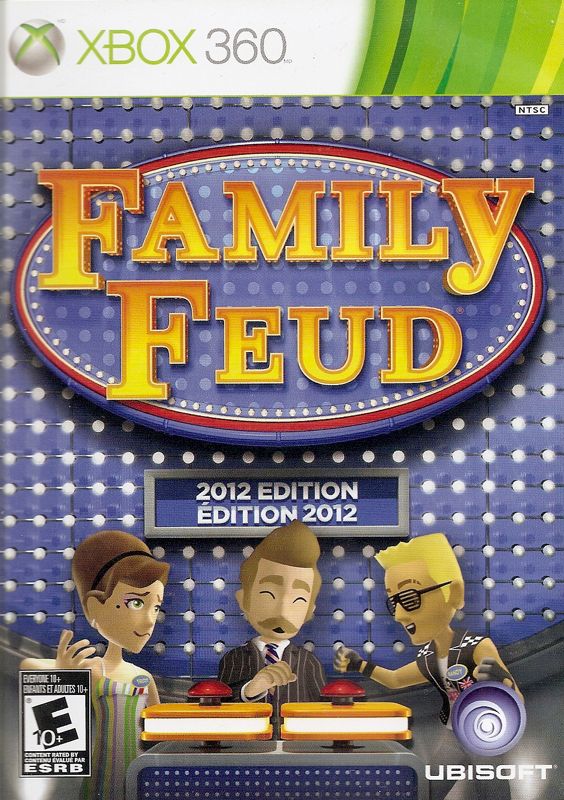
The game puts your Xbox 360 avatar or Wii Mii into the TV-show setting, while Challenge mode dresses its opposing families into themed alcoves such as a beach, mansion, spaceship, prehistoric den, haunted house, private boat, bowling alley, and more. These locations add some welcome variety around a format built around the answer board and host.
Bonus Steve Harvey videos give the licensed package a little extra show flavor. The clearest visual pleasure is simply seeing your own avatar or Mii take part in a familiar game-show setup alongside friends.
Story
There is no campaign story to carry you from one match to the next. The game follows the television format: two families compete over survey answers, and the winner reaches Fast Money.
That makes every round its own tiny anecdote. One family builds momentum, another gets three strikes, and a last-second steal changes the mood in the room. The drama is light, but it is immediate because everyone understands what is at stake.
Challenge mode supplies the closest thing to progression by pitting your group against 16 themed families. Do not come looking for character arcs or a larger narrative; come for the familiar game-show structure and the stories your group creates from its own wild guesses.
Overall Experience
Family Feud: 2012 Edition is an easy recommendation for a small group that likes shouting answers at the television and can laugh when the survey board disagrees. Its strongest moments are social ones: the buzzer race, the choice to play or pass, and the scramble to find a steal before the other side escapes with the points.
On your own, the format has less room to surprise you. Even with a large pool of questions and Challenge mode, the loop remains deliberately narrow. The game cannot turn survey guessing into something deeper than survey guessing, and the annoyance of an omitted “obvious” answer is part of the deal.
Still, it captures the core tension of the show without burying it under extra clutter. If you want another take on the license, the earlier Family Feud game on NES makes for an interesting series comparison. This 2012 edition is the better bet when you have a few people ready to turn a simple quiz into a noisy evening.


Reviews
There are no reviews yet.