 Retro Replay Retro Gaming History, Reviews & Emulation
Retro Replay Review
Gameplay
The first few duels make a strong case for Swords. You face an opponent head-on, watch their body for the incoming cut, and move the Wii Remote into the matching defensive angle. When the block lands perfectly and leaves them exposed, the return strike feels earned. It is a simple rhythm, but it asks for attention instead of indiscriminate swinging.
MotionPlus helps sell the basic fantasy, though the game is not reading every nuance of a real sword stroke. Attacks resolve through seven directions: up, left, right, and four diagonals. That constraint gives the fights a more game-like clarity, but it can also make them feel rigid once you understand the vocabulary. Success comes from recognizing the correct response, especially the targeted block, rather than from improvising elaborate blade work.
Holding A to charge Chi adds a special option, while the core loop remains block, counterattack, and defend again. That makes Swords easier to settle into than a more demanding fighting game, and it rewards patience. Frustration can set in if you expected freeform motion-controlled fencing; the best approach is to treat each bout as a read-and-react duel.
Campaign breaks its battles with minigames involving zombies, thrown objects, log-cutting shapes, and timed strikes against armor. They are useful palette cleansers because they ask for different motions between one-on-one encounters. Quick-Match and Quick-Minigame make unlocked opponents and challenges easy to revisit, while Versus lets two people fight as Hiro and Jake. The local competitive option is a nice extra, but the campaign’s opponent-reading is clearly the main attraction.
Graphics
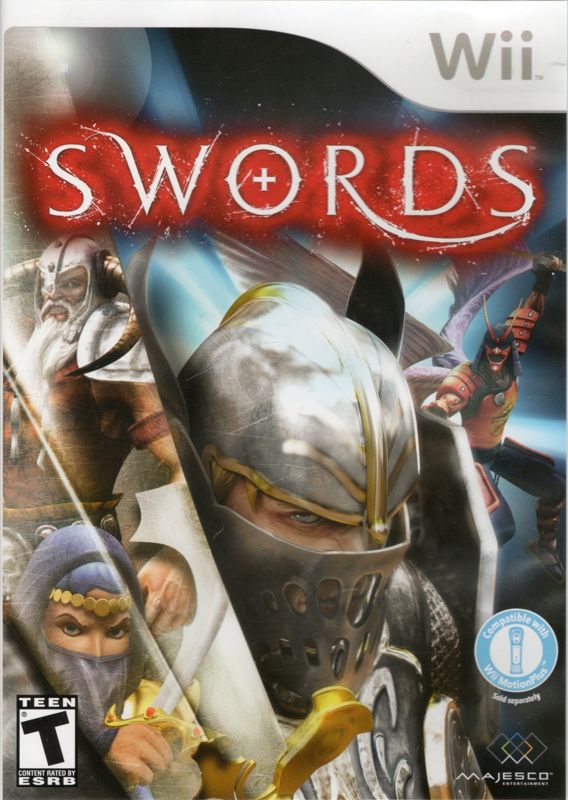
The action uses a head-on view from behind Hiro’s transparent on-screen body, keeping the opposing fighter in clear focus. The campaign’s Viking, pirate, knight, and Arabian princess give the eight opponents broad, immediately recognizable fantasy-game looks. It is a functional setup for reading attacks first and admiring characters second.
Story
You play Hiro, a student pushed through a sequence of duels by Sensei Musashi. The Sensei teaches the basics, offers tips, hands out new weapons, and fills in the game’s story arc as you advance. It gives the campaign a friendly training-hall structure.
Don’t come in expecting a densely developed fantasy tale. The story mainly exists to carry Hiro from one colorful challenger to the next, with the Sensei acting as the connective thread. That is enough for this kind of game, since each new fight is the real destination.
The themed roster does help the journey avoid feeling completely anonymous. Facing a pirate after a Viking or a knight gives each stop a distinct surface flavor, even when the narrative is not the reason to keep playing. Hiro’s progression works because it keeps returning you to the next test of observation and timing.
Overall Experience
Swords is at its best when you slow down and let an enemy commit. A correctly angled Perfect Block followed by a counterattack creates the sort of small, sharp victory that motion controls were made for. The game understands that a sword duel needs tension before the hit, not merely a lot of arm movement.
Its weakness is that the same disciplined design can feel narrow. Seven attack directions and a block-counter structure give the duels definition, but they also mean the game has less room for expressive swordplay than its Wii Remote premise suggests. The campaign’s eight opponents are enough to establish the formula, not enough to make it feel expansive.
Give it a chance if you want a focused Wii MotionPlus game with Punch-Out!!-style opponent reading translated into sword fights. Skip it if your ideal fencing game means unrestricted movement or a deep fighting-game system. For the right mood, its measured duels, varied breaks, and satisfying counters make for a likable if limited slice of motion-controlled action.


Reviews
There are no reviews yet.