 Retro Replay Retro Gaming History, Reviews & Emulation

Retro Replay Review
Gameplay
The first hour has a wonderfully blunt kind of tension: you are ruler of Athens, the treasury is finite, and nearly every choice pulls against another. Train troops and you weaken the funds needed for ships or food. Build merchant vessels to support trade and you may feel exposed when a hostile fleet arrives. Tyrant of Athens understands that a strategy game does not need a huge map or a mountain of rules to make you sweat; it just needs decisions that refuse to stay safely separate.
The annual-turn structure gives each decision time to sting. You set military training, commission warships and merchant ships, arrange food imports or exports, and decide which allies receive citizenship. None of that is busywork, because the costs all land in the same treasury and the population still needs feeding. Citizenship is especially pointed: it can strengthen your position, yet allies may desert or rebel. You are not simply expanding a neat empire on paper; you are gambling on how much instability you can afford.
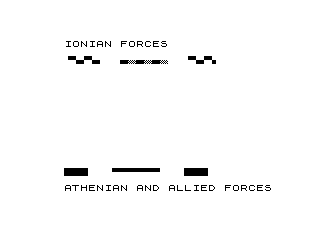
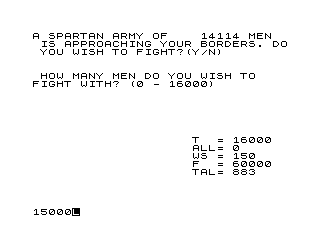
Attacks force the clearest version of the game’s central question: fight, or pay tribute? A well-prepared response feels earned because it reflects earlier sacrifices, while a tribute payment can be the bitter consequence of having invested in the wrong priority. Frustration can set in when disasters and defeats cut a run short, particularly if you thought you had planned conservatively. But that severity belongs to the design. With a maximum of 30 turns, Tyrant of Athens favors reassessment and another attempt over a long, forgiving campaign.
Graphics
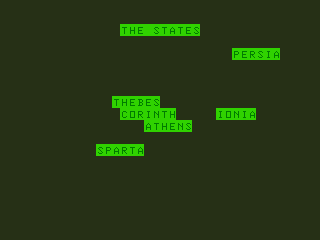
On ZX Spectrum, Tyrant of Athens keeps the focus on its city-state decisions and yearly outcomes rather than turning ancient Greece into a visual travelogue. The Greek setting comes through chiefly in the things you are asked to manage—Athens, rival cities, Persia, fleets, grain, and tribute.
Story
This is a historical-pressure story more than a scripted narrative. You begin in fifth-century BCE Athens, boxed in by rival Greek cities and the Persian Empire, and the drama comes from whether your rule holds together under that pressure. Every year can alter the shape of your reign: an ally may remain useful, slip away, or become a rebel; an enemy may demand a military answer or a humiliating payment.
That spare approach suits the subject. You are not guided through a fixed account of Athenian history; you make the kind of hard civic choices that let your own version of Athens emerge. A prosperous trading policy, a heavily armed city, or a desperate state buying peace with tribute each tells a different story about the ruler you became.
The limitation is that the premise carries the narrative weight on its own. If you need character-driven drama or a sequence of authored historical episodes, the game’s tale may feel distant. If you enjoy supplying the meaning yourself through consequences, the constant risk of disaster, defeat, desertion, and rebellion gives even a compact campaign a credible sense of political fragility.
Overall Experience
Tyrant of Athens is a compact strategy game with a nasty, satisfying instinct for forcing trade-offs. It is easy to understand why one more attempt would be tempting: a failed run does not necessarily feel like random punishment, but like the result of putting too much faith in one part of the state while neglecting another. The best moments arrive when a decision that looked miserly or overly cautious a few turns earlier suddenly saves the city.
Its age and stripped-down scope will not suit everyone. There is little room here for leisurely empire-building; you are continually accounting for food, treasury costs, military readiness, trade, allies, and threats. That concentration is a virtue if you want strategy reduced to consequential choices, but it can feel harsh if you prefer a game that lets you recover comfortably from a weak year.
Give it a chance if Hammurabi-style management games appeal to you and you enjoy campaigns where survival is a real accomplishment. Tyrant of Athens does not need many turns to create a meaningful rise-or-fall arc. It is demanding, austere, and sometimes punishing, yet the payoff is a surprisingly tense lesson in how quickly a city-state can be stretched beyond its means.



Reviews
There are no reviews yet.