 Retro Replay Retro Gaming History, Reviews & Emulation

David Michel created Magic Engine, a 1997 PC Engine emulator that aimed beyond HuCards toward the console’s CD games. His work showed that a paid emulator could be part of the same lively technical conversation as free projects.
Name: David Michel
Known for: Magic Engine for PC Engine
1997 milestone: DOS release pursuing HuCard and CD games
Distribution: Commercial shareware
A different corner of the console map
The PC Engine was not as universally familiar in English-language emulator discussions as the NES or SNES. In North America it was known as the TurboGrafx-16, while Japanese HuCards and CD releases gave it a library with different regional identities. That made an emulator especially valuable to curious players who had never owned the machine or had only encountered part of its catalog. It also made the documentation problem harder. A program had to reproduce the hardware, and a website had to explain what kind of game image a user was looking at.
Michel’s Magic Engine appeared for DOS in October 1997, according to surviving emulator histories. It was notable for work on both HuCard and CD titles. CD support is easy to describe and difficult to implement well. Loading data is only one part; timing, audio, and a game’s assumptions about the disc mechanism can all matter. An emulator that could attempt those games was expanding the scene’s idea of what a home PC might preserve. Its early results still required careful qualification, just as every first release did.
Magic Engine used a commercial shareware model. A limited demo let people try the software, while a paid version removed the restriction. That put it in a different relationship with users than a freely shared DOS ZIP. Some fans preferred free emulators on principle; others were willing to pay for a polished route into a library they loved. The existence of both Magic Engine and Jens Christian Restemeier’s VPCE in 1997 shows that the scene did not have one settled business model. The projects could be compared technically while offering different terms of use.
The value of polish

An emulator’s value was not only how many CPU instructions it understood. A user needed to launch a game, configure controls, adjust performance, and understand why a CD title behaved differently from a HuCard. Magic Engine developed a recognizable presentation around those needs. Later screenshots in archives show a more mature interface; they should not be mistaken for the October 1997 screen. What matters for the early history is that Michel treated usability and broad hardware support as connected goals. Recreating a console is a technical task; making the result inviting is a design task.
Magic Engine’s approach also challenged a common assumption that emulation was only a hobby carried out for free. Writing and maintaining software for an unusual game system took time, and Michel chose to charge for the full version. That choice did not automatically make the program better or worse than a free alternative. It did make users ask what they were buying: compatibility, CD support, performance, support, or simply a developer’s continued attention. Those questions were present in 1997 and remain recognizable in software today.
Connections to other projects
Michel was not confined to the PC Engine. Retrospective accounts of xNES identify him among people who helped the developing NES project. This cross-project role is significant because emulator work often yielded reusable ideas and components. A programmer studying one machine learned how to structure another emulator, how to deal with file formats, and how to explain technical limits. Collaboration did not always mean a formal team membership or a line in a company org chart. It could be advice, a code contribution, or a discussion that saved someone else from repeating a mistake.
Magic Engine itself later expanded and changed. Those developments should be read in their own years. The 1997 moment is the launch of a PC Engine emulator with an unusually ambitious CD target and a distinct commercial model. Keeping that boundary prevents a modern feature list from overwhelming the fragile first release. It also lets us see why the program attracted attention when so many other emulator names were competing for a reader’s time.
The person and the evidence
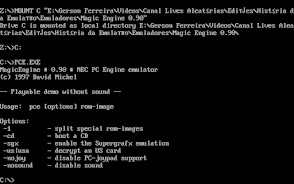
The public record used here identifies David Michel as the creator and associates later work with his brother Cédric Michel. It does not provide a verified 1997 portrait. The question-mark portrait placeholder is followed by a later Magic Engine screen with an explicit caption. That software is the reason Michel belongs in this People index; a speculative personal photo would add little. The best sources for his 1997 importance are the dated project history and the way contemporary lists placed Magic Engine beside VPCE and other PC Engine efforts.
Michel’s story broadens the year’s history. While NES and SNES programs dominated the loudest arguments, he was making a less familiar console accessible, including its CD-based side, and showing one way to sustain that work commercially. A player who discovered a PC Engine game through Magic Engine experienced the same central 1997 surprise as a MAME or NESticle user: hardware that had once seemed inseparable from its original box could speak through a PC.
David Michel in the History of Video Game Emulation
1997 Part II: The 16-Bit Race, PlayStation Dreams, and a Public Fallout
David Michel enters this history in the 1997 chapter. created Magic Engine for the PC Engine and helped other emulator projects. His work shows how knowledge and code traveled between teams and machines.
Related People
- Steve Snake — wrote KGen in the crowded Genesis field. His work helped make Sega games feel increasingly accessible on ordinary PCs.
- Marcin Dudar (Duddie) — built the early PlayStation emulator PSEmu. In a 1997 interview he described the painstaking reverse engineering behind a project many people thought impossible.