 Retro Replay Retro Gaming History, Reviews & Emulation

Steve Snake’s KGen helped make Sega Genesis and Mega Drive emulation a practical PC hobby in 1997. His dated release notes show an author balancing speed, sound, compatibility, and the ordinary constraint of having a job outside the project.
Name: Steve Snake
Known for: KGen for Sega Genesis
1997 work: Speed, sound, and game compatibility on DOS PCs
Later name: KGen ’98 followed the 1997 releases
The machine he wanted to hear correctly
Genesis games were recognizable from their colors and scrolling, but their sound was just as much part of their identity. Reproducing Sega’s hardware on a PC required work on the Motorola 68000, the Z80 sound controller, and the YM2612 FM sound chip, among other components. Steve Snake approached those problems through KGen, a DOS emulator whose 1997 releases attracted players comparing it with GenEm and Genecyst. The project was not merely a graphics demo. Its ambition was a game that moved and sounded convincingly enough to play.
Snake’s own KGen documentation identifies the project as written in 1997 and gives a detailed change history. It describes fixes for games that initialized hardware unexpectedly, improvements to shadow and highlight effects, work on the 68000 and Z80 emulators, and revisions to sound behavior. Such notes are more revealing than a simple compatibility percentage. They show how one game exposes a hidden assumption, how a small fix can improve several titles, and how hard it is to make “runs most games” mean the same thing on two different PCs.
The September 1997 notes also mention a graphical menu and a busy workload outside emulation. That detail matters. Users could watch weekly download pages and imagine authors spending every waking hour on their favorite emulator. Snake was fitting the work around other responsibilities. A delay could mean a job had become demanding, not that the project was abandoned. His notes convey a practical programmer’s voice, sometimes amused and sometimes impatient with requests, while the code kept moving forward.
Performance as access
KGen’s appeal depended on running well on machines people owned. A project could strive for perfect component-level accuracy and still be too slow for most users in 1997. Snake’s changes often aimed at making the emulator both more correct and more efficient. The release notes discuss improvements on Pentium-class PCs rather than assuming everybody had a top-end machine. That focus made the program useful to the fan who wanted to play an old favorite after dinner, not only to someone benchmarking a technical proof.
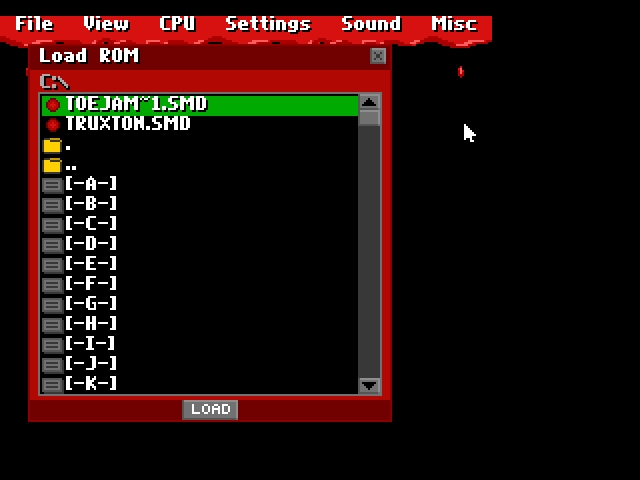
The menu system was part of the same practical impulse. Command-line software can be precise, but a person browsing a library of Genesis games wants to see options and select a title without memorizing switches. The move toward a friendlier interface did not replace the CPU and graphics work; it let more people benefit from it. KGen’s development belongs beside MAME32 and other 1997 front-end efforts in a larger story about making emulator programs usable beyond the original technical audience.
Competition without a single champion
Bloodlust Software’s Genecyst appeared in the same broad Genesis conversation. Fans compared speed, sound, graphics, and which game happened to work. Those comparisons could be useful reports and unfair verdicts at the same time. An emulator might excel at one cartridge and stumble on another because the games used different hardware behaviors. Snake’s KGen was therefore not in a simple footrace that ended when one program gained a feature. It was one sustained effort in a developing field.
Later Sega-related work gave Snake a broader reputation, including the KGen98 and Kega lines, but those developments belong to later years. The 1997 biography should not use a future commercial connection or later compatibility to inflate KGen’s debut. What the contemporary release notes already show is substantial: a programmer investigating the Genesis carefully, documenting bugs and fixes, and giving DOS users a workable route into its library. That is enough to explain why his name belonged on a 1997 emulator news page.
What survives of the author
The most trustworthy portrait of Snake’s 1997 priorities is written rather than photographic. His release notes show his priorities and frustrations in his own words, while surviving directories identify the program and later builds. The image above is a later portrait identified as Steve Snake in the research archive; it is not presented as a 1997 photograph. The dated software record, rather than the face, tells us what he was making that year.
Steve Snake’s importance lies in the experience his code made possible. Sega’s hardware had a particular sound and rhythm; a PC emulator that captured enough of them let players recognize a game as more than moving sprites. He pursued that standard in the midst of rapid public comparison, with the limits of a real work schedule. KGen’s 1997 record shows the craft behind a deceptively simple sentence: “the game runs.”
Steve Snake in the History of Video Game Emulation
1997 Part II: The 16-Bit Race, PlayStation Dreams, and a Public Fallout
Steve Snake enters this history in the 1997 chapter. wrote KGen in the crowded Genesis field. His work helped make Sega games feel increasingly accessible on ordinary PCs.
Related People
- Icer Addis (Sardu) — released NESticle and then tackled Genesis and Capcom arcade hardware. The Bloodlust programmer made emulation feel fast, playable, and impossible to ignore.
- David Michel — created Magic Engine for the PC Engine and helped other emulator projects. His work shows how knowledge and code traveled between teams and machines.