 Retro Replay Retro Gaming History, Reviews & Emulation

Paul Robson created NESA, a compact DOS emulator that appears in the expanding NES scene of 1996. Written in assembly language and distributed with source available, it offered a different development approach from portable emulators such as iNES. NESA is a useful record of a period when executable size, host-machine speed, and the ability to study another programmer’s implementation were important parts of emulator culture.
Name: Paul Robson
Best known here for: NESA, an NES emulator for DOS
Implementation: Assembly language
Preserved versions: 0.11 beta screen with a 1996 credit; 0.17 catalogued in October 1996
Why he matters: An early example of compact, source-available NES emulation
A Small Emulator for a Demanding Job
Reproducing Nintendo’s 8-bit console on a PC required considerably more than translating a few CPU instructions. The graphics hardware, memory map, cartridge circuitry, and timing all affected whether a game would run. The host computer had to do that work quickly enough for the result to be useful.
NESA approached that problem with an assembly implementation. Its design could be tailored closely to the PC, at the cost of making the code harder to move to a completely different processor or operating environment. That was a practical tradeoff when usable speed could matter more to a user than the possibility of a future port.
What the Surviving Releases Establish
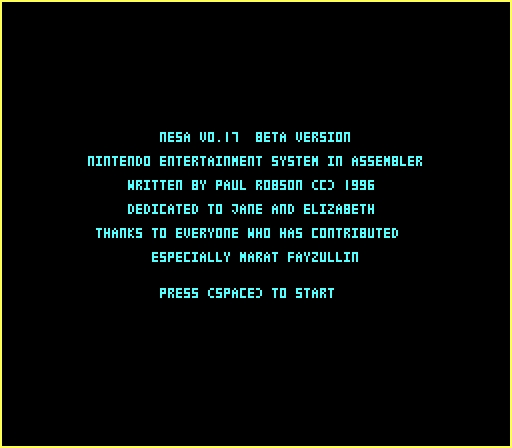
The preserved 0.11 beta screen names Paul Robson and carries a 1996 copyright. It also acknowledges Marat Fayzullin. This places a small independent program within a larger exchange of information rather than presenting its author as working without predecessors or collaborators.
Archaic Ruins catalogues NESA 0.17 on October 11, 1996, describes it as pure assembly, and points readers toward its source code. The listing gives a 13,370-byte download size. That is the archive’s ZIP-file size; it should not be repeated as the exact size of the executable.
Source Code as Part of the Scene
Making an implementation available to read offered something a screenshot could not. Other programmers could inspect how a problem had been approached, compare it with documentation, and use the program as evidence of what was possible. Source availability does not by itself establish a modern open-source license, so the narrower description is the appropriate one here.
The same period catalog also mentions Robson’s A26 and other emulators, suggesting a wider interest in small implementations. NESA is the project that brings him into this Nintendo chapter; the surviving credits and catalogs provide firmer ground than an expanded personal biography assembled from unrelated people with the same name.
Why Paul Robson Matters
NESA did not need to become the final word in NES accuracy to matter. It records an alternative answer to the constraints of 1996: a small program, a specific host machine, and code that other people could examine. No verified portrait was established in the sources used for this profile, so Retro Replay retains its standard placeholder.
Paul Robson in the History of Video Game Emulation
1996 Part I: iNES, Snes96 and the Nintendo Emulation Race
Paul Robson enters the timeline in the chapter about Nintendo emulator development in 1996.