 Retro Replay Retro Gaming History, Reviews & Emulation
Retro Replay Review
Gameplay
Cubic Tic Tac Toe earns its name immediately: you are not simply filling squares on a single board, but considering a 3x3x3 cube full of possible three-in-a-row lines. That one change gives every move more weight. A square that looks harmless from one angle may complete a diagonal route through the cube, and the opening game has a pleasingly disorienting quality as you retrain your eyes to see it.
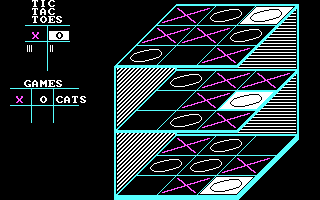
What starts to click is the need to think in layers rather than chase the most obvious row. You need to watch horizontal, vertical, and diagonal alignments at once, while also remembering that scoring more tic-tac-toes than your opponent wins the game. That scoring focus is a smart twist on ordinary Tic Tac Toe: filling one line does not end the contest, so there is room to recover, counterattack, and make several good reads in a single game.
Its frustration is equally clear. The cube asks you to hold a lot of line possibilities in your head, and a missed diagonal can make you feel as though you lost to the board rather than to a clever opponent. Still, that is also why the game works. Against the computer or another person, the satisfaction comes from gradually seeing routes that were invisible an hour earlier.
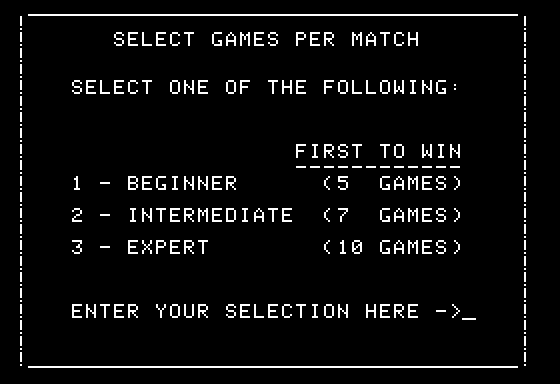
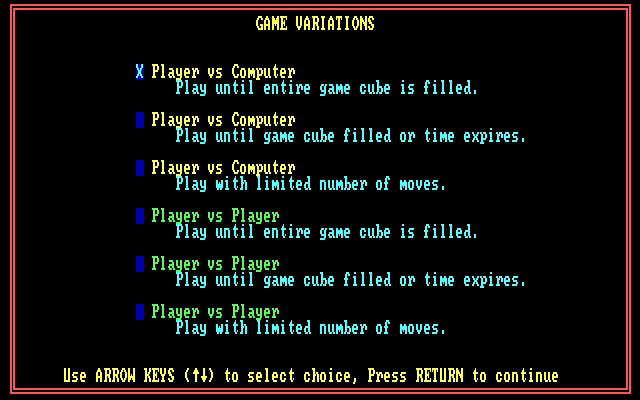
Three variations and three match-length difficulty levels give the format some welcome flexibility. A short match is a good way to learn the cube without turning every decision into homework, while longer contests better reward careful play. The tie rule, which awards a tied game to CATS, also means you cannot drift into a draw and call it even; every game needs a decisive edge.
Graphics
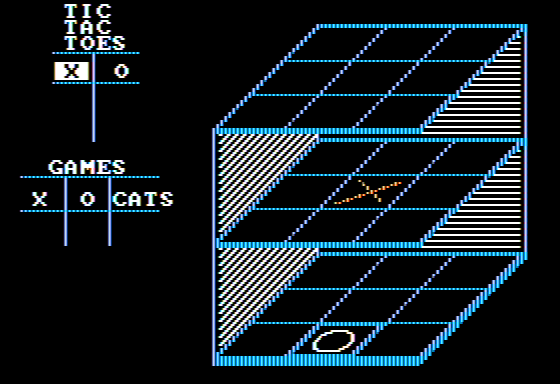
The isometric view is the right fit for a cubic Tic Tac Toe board. It gives the 3x3x3 playfield a visible sense of depth and helps distinguish this from a flat grid, while the X placements make the important information easy to focus on during a turn.
Story
There is no character drama or campaign to carry you forward. The “story” is the changing shape of a match: an early line you overlook, a block that saves a game, and the tension of trying to win more games than your opponent.
That stripped-down approach suits the material. Tic Tac Toe has always been about reading a board and anticipating a reply, and the cube supplies enough new possibilities that it does not need extra framing to create stakes.
The closest thing to a narrative arc is your own improvement. At first, you are likely to scan for familiar rows; later, you start noticing diagonals and vertical routes before they become disasters. That small personal learning curve is the game’s real hook.
Overall Experience
Cubic Tic Tac Toe is a smart little strategy game built around one worthwhile idea: regular Tic Tac Toe becomes much more interesting when the board has depth. It does not overwhelm you with rules, but it does demand concentration, especially once you realize how many directions a winning line can take.
Give it a chance if you enjoy abstract head-to-head games where a clean rule set hides a surprising amount of thought. Two-player matches are the natural fit, since another human can share in the discoveries and blunders, but the computer opponent gives you a way to practice seeing the cube on your own.
The payoff is modest but real. You will not come for elaborate spectacle; you come for the moment when a three-dimensional line snaps into focus and a board that once looked confusing suddenly becomes legible. For a 1985 board-game conversion, that is enough to make it a memorable variation on a familiar classic.

Reviews
There are no reviews yet.