 Retro Replay Retro Gaming History, Reviews & Emulation



Retro Replay Review
Gameplay
The first hour is largely about learning to think like an air commander rather than a pilot. Before you send anyone aloft, you are checking weather, intelligence, and readiness, then comparing them against squadron strength, losses, morale, and experience. That pile of information could feel dry, but it gives every commitment a consequence. A weakened squadron is not just a number you ignore until the next turn; it is part of the force you will need when the next raid arrives.
Choosing sides is more than a cosmetic swap. As the Germans, your job is to damage British airbases, radar stations, and industrial centers badly enough to reduce the enemy’s aircraft capability. As the Allies, you are trying to break incoming raids before they can reach those targets. That contrast makes the game worth revisiting: one side measures success through pressure and destruction, while the other must make careful defensive choices with limited strength.
The southern England map is the heart of the decision-making, since it lets you allocate planes and targets without getting lost in the reports. What starts to click is the connection between the map and the daily status data. You are not simply chasing a fight; you are deciding where a tired, experienced, or depleted unit can matter most. Frustration can set in if you want immediate, dramatic feedback from every order, because Fighter Command puts its emphasis on the slow accumulation of operational advantage.
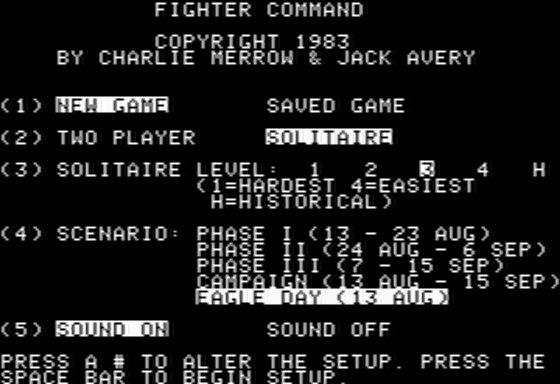
The selectable scope is one of its smartest concessions. Adlertag offers a focused August 13, 1940 scenario, 10-day phases let you test your judgment over a manageable stretch, and the full campaign runs 34 turns from August 13 to September 15. Start small. A shorter operation teaches the rhythm of reports, allocation, and attrition far better than diving straight into the full campaign and being buried by its demands.

Graphics
Fighter Command uses a top-down view centered on its map of southern England, alongside detailed charts for squadron condition. The map gives plane and target allocation a clear geographic frame, while the numerical screens put strength, losses, morale, and experience directly in front of you. It is a functional, information-heavy look built for following a campaign rather than admiring aircraft.

Story
There is no need for a fictional layer here: the tension comes from commanding either side during the 1940 Battle of Britain. The German campaign is framed around breaking Britain’s ability to field aircraft; the British campaign is about stopping raids before that damage is done. That creates a naturally escalating contest in which every day can alter the condition of the air forces.
The dates give the campaign a useful sense of pressure. A single Adlertag operation can be treated as a concentrated test, but the full August 13 to September 15 run asks whether your decisions can hold up across the wider battle. Losses, morale, and experience carry the historical conflict from an abstract backdrop into the practical concerns behind your next order.
Its historical framing will land best if you enjoy strategy games that let the situation tell the story. You are not following a cast of characters or waiting for authored drama; you are watching the campaign develop through damaged targets, depleted squadrons, and the changing ability of each side to continue the fight. For background on the game itself, this history of Fighter Command: The Battle of Britain is useful context.
Overall Experience
Fighter Command earns its tension through responsibility. The reports and charts are not decoration around a battle; they are the battle, because they tell you what your air force can still afford to do. If that sounds inviting, the game’s methodical pace becomes a strength. Each turn has the satisfying weight of a decision made with incomplete information and resources you cannot casually replace.
Its age shows in how much it expects you to meet it halfway. You need to be comfortable studying figures, comparing unit condition, and accepting that an effective campaign is built over turns rather than won by one flashy move. Gamers looking for direct flying action or a fast tactical brawl will likely find the process austere.
For anyone drawn to compact historical wargames, though, the payoff is real. The asymmetric objectives, the daily operational reports, and the option to practice with shorter scenarios give it more staying power than a one-note historical recreation. It is a demanding command game, but a thoughtful one: start with Adlertag or a 10-day phase, learn what the reports are trying to tell you, then take on the full campaign when you are ready to live with the consequences.


Reviews
There are no reviews yet.