 Retro Replay Retro Replay gaming reviews, news, emulation, geek stuff and more!



Retro Replay Review
Gameplay
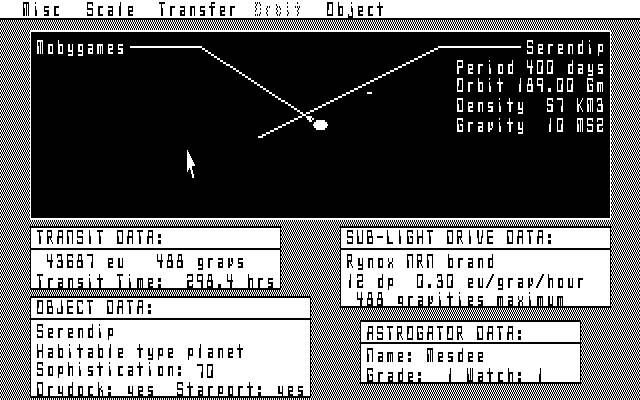
Universe II is at its most compelling when you stop treating the undercover assignment as a straight line and start treating the Local Cluster as a place where you need to survive. The Federated Worlds will help on special missions, but your day-to-day income is your problem. That creates a satisfying early-game pressure: take a freight job, try your hand at trade, look for minerals, carry passengers, chase a bounty, or make a less respectable living through smuggling and piracy. You are not simply selecting a mission type; you are deciding what kind of captain you can afford to be.
The ship outfitting is the heart of that fantasy and also the reason this is a demanding game. You can buy different hulls and fill them with drives, weapons, scanners, life support, computers, bridge modules, crew quarters, and much more. Parts have trade-offs beyond price. They occupy space, endure different amounts of damage, can be more likely to take a hit if they are highly visible, and may require a special drydock when their sophistication makes ordinary repairs impossible. That is wonderfully granular if you like planning a ship around a job instead of chasing one universally best build. It can feel merciless if you just want to get airborne and follow the plot.
Crew management deepens that commitment. Captains, astrogators, gunners, pilots, miners, marines, and engineers are not decorative hires: specific work depends on specific specialists. A missing miner stops mining; without engineers, damaged systems cannot be repaired. You must pay and feed everyone, assign watch cycles for sleep, and live with rising salaries as experience accumulates. Training gives you a way to improve the roster, but it costs credits. The result is a game where a profitable run can matter because it keeps the people who make the ship work from walking out.
Combat has more bite than a simple exchange of shots. Boarding actions ask your marines to seize an enemy bridge by defeating opposing marines or taking control panels, while planetary mining against resistance first means dealing with defense stations. These encounters use dedicated tactical screens, giving the violent side of your career a more deliberate, turn-based feel. That extra detail fits the rest of the game: success comes from preparation, personnel, and accepting that a bad decision can have consequences beyond a damaged hull.
Graphics
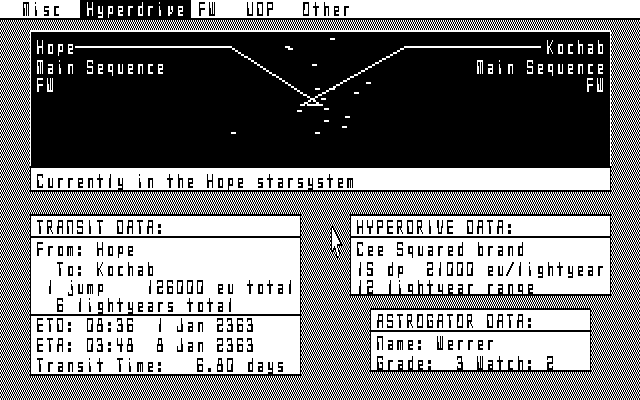
Universe II replaces its predecessor’s general text-based interface with a menu-driven window system in the mold of contemporary GEM or Macintosh software. The dedicated tactical screens separate boarding and assault actions from the broader ship-management view, making those confrontations easier to treat as distinct operations rather than just another line of text.
Story
There is a solid tension under all the commerce and maintenance. Twenty years after the first Universe, the discovery of a second hyperspace booster raises the prospect of restoring contact with Earth. Closer to home, the Federated Worlds and United Democratic Planets remain able to trade and travel, yet both sides expect their rivalry may become war. You operate inside that uneasy gap as a Federated Worlds agent posing as a trader from Vromus Prime.
That setup works because it does not demand that every hour be espionage. Your cover identity naturally explains why you are hauling cargo, buying equipment, talking to strangers, and scraping together credits. The strategic conflict gives your special assignments context, while the open-ended career makes the role feel lived-in rather than scripted.
Starports are where Universe II leans furthest into adventure-game territory. Docking shifts into text-parser sequences in which you can explore bases, speak with characters, and uncover useful items or clues. If you enjoy typing commands and poking at spaces for leads, these sections offer a welcome change from windows full of ship decisions. They also reinforce the sense that information can be as valuable as cargo.
Overall Experience
Universe II is not a casual space romp. It asks you to understand a lot, then makes that knowledge matter: the right hull for the job, the right system in the right slot, the right people on payroll, and enough provisions to avoid a slow disaster. Frustration can set in when one neglected detail turns into a stalled plan, particularly because the game models crew needs and equipment limits so closely. But for the right kind of player, that friction is precisely where the stories come from.
The payoff is an unusually broad captain’s life. You can build toward honest commerce, specialist mining, armed bounty work, illicit trade, or piracy, and the customization lets those choices shape more than a label on a save file. The tactical combat and parser-driven starports prevent the journey from becoming nothing but buying low and selling high, though they retain the same old-school willingness to ask for patience.
Give it a chance if you enjoy simulations with RPG-like crew growth and enough moving parts to make every credit feel earned. Skip it if your ideal space game quickly funnels you toward clear objectives and minimal administration. For a later stop in the series, Universe 3 continues the Universe line, but Universe II stands as the entry for gamers who want their interstellar freedom tied firmly to responsibility.


Reviews
There are no reviews yet.