 Retro Replay Retro Gaming History, Reviews & Emulation
Retro Replay Review
Gameplay
The opening matches have that great falling-puzzle urgency: pairs of colored blocks are dropping, the stack is getting uncomfortably high, and you are trying to create a clean three-or-more match before your next placement ruins the plan. You can pick it up quickly if you know Puyo Puyo, yet it does not feel like a thoughtless copy. The small blocks are the key wrinkle, because they stay put when matching regular blocks disappear and only grow into regular blocks when a neighboring clear triggers them.
That rule makes early play pleasantly deceptive. At first, you may treat the smaller pieces as awkward clutter and settle for modest clears. Then the chain-building logic starts to click: place regular blocks where they can activate a pocket of small ones, let those grow, and turn a basic clear into a delayed follow-up. Pulling that off is the reason to keep playing. A board that seemed messy a second ago can suddenly become ammunition.
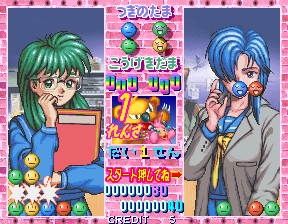
Matches are won by sending batches of small blocks to the opposing matrix until the other side cannot clear enough space and fills up. That makes every useful chain feel aggressive rather than merely tidy. You are not chasing a high score in isolation; you are buying your opponent less room to breathe. Against a COM opponent or another person, the pressure rises naturally as both stacks climb.
Frustration can set in if you never move beyond reactive clearing. The board has little mercy once incoming blocks begin to pile up, and a poorly placed pair can close off the space needed for your intended chain. Still, the rules are clean enough that most losses point back to a decision you can improve next time. Give it a chance if you like competitive puzzle games that reward setup and nerve more than elaborate mode structure.
Graphics
The action is built around two side-by-side play matrices filled with brightly colored paired blocks, regular blocks, and their smaller counterparts. That simple layout keeps the important information in view: how high each stack has grown, where a match is forming, and which side is about to be buried.
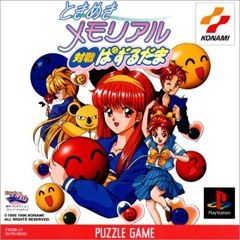
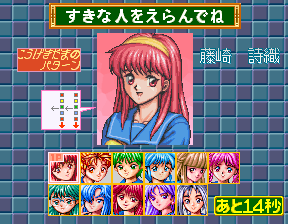
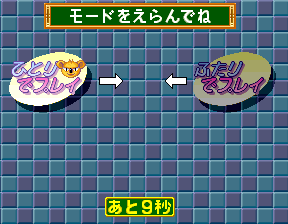
The Tokimeki Memorial connection puts the series’ girls at the center of the match selection, giving the arcade puzzle format an anime character wrapper rather than leaving it as a completely anonymous head-to-head contest.

Story
This is a Tokimeki Memorial spin-off that trades the dating-game premise for direct puzzle battles. You choose from the different girls and face a rival across the two boards, so the character connection works chiefly as match framing and personality around the competition.
That is a sensible fit for the format. A falling-block duel needs immediate stakes, and a familiar character opponent gives each round a little more flavor than battling a blank computer portrait. The real drama comes from whether your planned chain fires before the other matrix fills.
If you want to stay with the broader series after the puzzle detour, Tokimeki Memorial 2: EVS Append Disc is a related release worth noting. Here, though, the romance-series name is a light coating on a much more immediate contest of board control.
Overall Experience
Tokimeki Memorial: Taisen Puzzle Dama succeeds because its extra block rule changes how you read the board without burying you in complications. Normal blocks give you the instant gratification of a basic clear; small blocks invite you to think one or two reactions ahead. That balance makes it approachable in the first hour and increasingly satisfying once you start constructing chains deliberately.
It is strongest as a quick competitive game. A short round can swing from controlled to desperate very quickly, and the possibility of dropping a batch of small blocks onto the other side gives successful combos a sharp payoff. The game understands that a good versus puzzle match needs both planning and panic.
Come to it for a focused Puyo Puyo-style battle game with a Tokimeki Memorial cast, not for a grand expansion of the dating-game formula. If the idea of converting a careful color match into a board-filling attack sounds satisfying, this is an easy recommendation. Its depth is concentrated in the chain reactions, and that concentration is exactly what keeps the game lively.


Reviews
There are no reviews yet.