 Retro Replay Retro Gaming History, Reviews & Emulation
Retro Replay Review
Gameplay
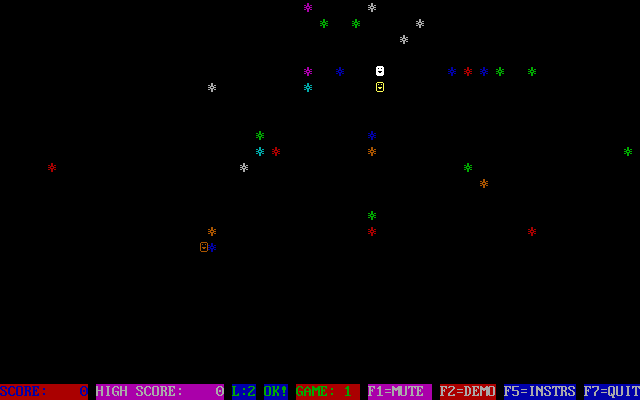
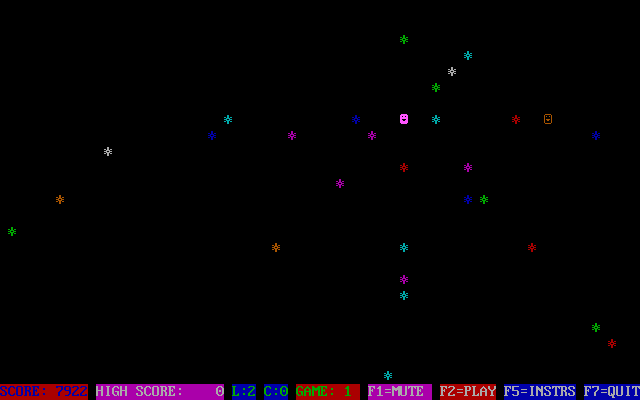
The first few minutes of Tommy’s Gorilla Ball Gotcha are funny because your instincts are completely wrong. Other gorilla balls arrive and head toward you, which sounds like a threat in almost any action game. Here, they are exactly what you want. Your problem is that you are radiating bad vibes along the four cardinal directions and four diagonals, turning a simple attempt to meet someone into a hazardous little dance.
That reversal gives the game a real hook. Instead of lining up an attack, you need to judge where an incoming gorilla ball is headed and find a route that lets it make contact without wandering into one of your eight streams. Random appearances keep the board from becoming a solved pattern, and the tension comes from trying to preserve space around yourself rather than clear it. It is less about precision shooting than resisting the urge to treat every moving target as something to eliminate.
The scoring system puts pressure on that idea. You begin with 10,000 points and steadily lose them over time; each gorilla ball struck by bad vibes costs another 100. That means caution alone is not enough, because lingering drains the score too. A round ends happily after you have been caught ten times, while running out of points ends the game at zero. It is a clean push-and-pull, although the constant accidental-fire premise can turn frustration into the main attraction if you dislike games built around avoiding your own attacks.
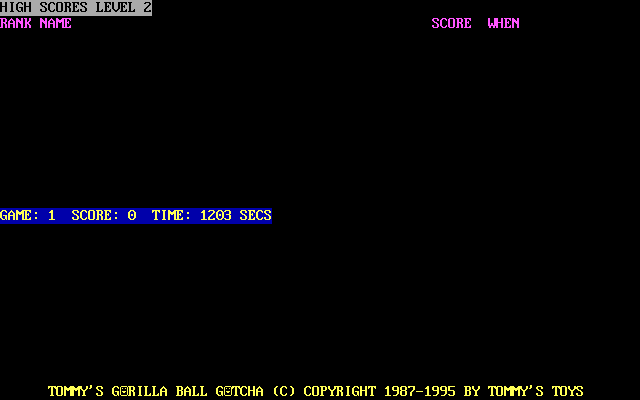
Nine difficulty levels and a separate top-ten list for each give the game more staying power than a single novelty round. If you enjoy chasing a cleaner score and gradually internalizing an unusual rule set, there is something to work on. If you need varied objectives or a broader action-game toolkit, the joke may wear thin quickly.
Graphics
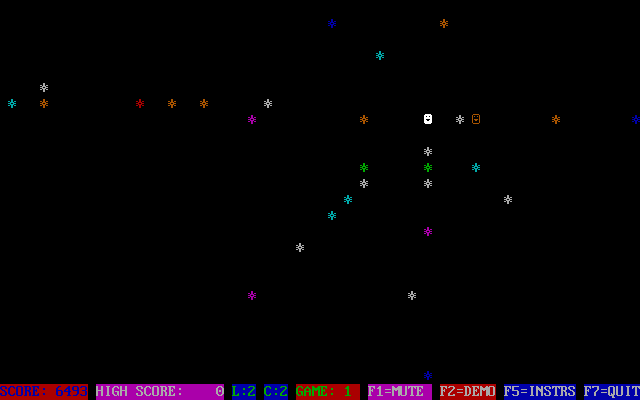
The screen is built around gorilla balls converging on the player, with the end of a successful game capped by a little dance. That is a fittingly silly reward for a game whose whole premise is trying to make a connection while accidentally driving everyone away.
Story
There is not much narrative to unpack, but the setup is unusually specific: you are a wallflower at a gorilla ball dance, discouraging possible partners with bad vibes despite wanting to be caught. It is a comic excuse for the reversed shooter rules, and it gives the score chase more personality than a generic survival contest.
The game understands the value of carrying one joke all the way through. “Bad vibes” are harmful projectiles, incoming figures are prospective dance partners, and being caught is the victory condition. The theme is not developed into a larger tale, but it does not need to be; it keeps the rules easy to remember.
The little dance at the end provides a proper payoff for reaching ten catches. It is a small touch, yet it makes success feel like the game has followed through on its strange social goal rather than merely stopped the timer.
Overall Experience
Tommy’s Gorilla Ball Gotcha is the kind of compact 1987 DOS game that lives or dies on one sharp idea, and this one is sharp enough to earn a few more rounds. The act of trying to welcome pursuers while your own eight-way emissions punish bad positioning has a pleasingly mischievous logic.
Its limits are also obvious. Everything leans on repeatedly managing the same central hazard, so your enjoyment depends on whether that reversal feels like a compelling score challenge or an intentionally awkward gag. The random arrival of potential partners adds uncertainty, but it does not change the fundamental task.
Give it a chance if you like old arcade-style games that ask you to unlearn familiar habits, especially if high-score tables motivate you. The payoff is modest but genuine: once the movement puzzle clicks, escaping your own bad vibes long enough to get caught becomes an amusingly upside-down test of nerve.


Reviews
There are no reviews yet.